The post The 7-Minute Standing Routine That Restores Core Strength Faster Than Floor Exercises After 60 appeared first on Eat This Not That.
]]>The core doesn’t just function on the floor, it works hardest while you’re upright, stabilizing your body during walking, reaching, and balancing. That’s why standing exercises often restore real-world core strength faster than traditional crunches or planks. When you train the core in a standing position, you teach it to support your body exactly the way it needs to during daily life.
This 7-minute routine focuses on continuous tension, posture control, and deliberate movement. Each exercise lasts just over two minutes, keeping the core engaged without rest. Stay tall, brace your midsection, and move with purpose. When done consistently, this routine rebuilds deep core strength that carries into everything you do.
RELATED: 5 Exercises Personal Trainers Recommend for Clients Over 60 Who Haven’t Worked Out in Years
Minutes 0–2:30 — Standing Knee Drive Hold
This movement locks in lower-core activation while challenging balance and posture. I use this often with clients who need to rebuild coordination and abdominal strength at the same time. Holding the knee at the top forces the core to stabilize the entire body, which creates deep engagement through the lower abs and hip flexors. When done correctly, you’ll feel the midsection working far more than during most floor exercises.
Maintaining an upright posture becomes critical here. As fatigue builds, the body wants to lean back or collapse forward. Resist that urge and keep your torso tall. That’s where the real strength develops.
How to Do It
- Stand tall with feet hip-width apart
- Lift one knee to hip height
- Hold for 2–3 seconds
- Keep core tight and posture upright
- Lower slowly and switch sides.
Minutes 2:30–5:00 — Standing Cross-Body Crunch
This exercise targets the entire abdominal wall while emphasizing rotational strength. I rely on this movement because it builds the kind of core control needed for everyday activities like turning, reaching, and walking. Bringing the elbow and knee together forces the obliques and lower abs to fire together.
Controlled movement makes all the difference. Fast reps reduce effectiveness. Slow, deliberate crunches create constant tension and better muscle activation. As the pace stays steady, the core remains fully engaged throughout the entire interval.
How to Do It
- Stand tall with hands behind your head
- Lift one knee across your body
- Bring opposite elbow toward the knee
- Return to start slowly
- Alternate sides continuously.
RELATED: 5 Standing Exercises That Build Walking Endurance Faster Than Treadmills After 65
Minutes 5:00–7:00 — Standing Anti-Rotation Hold (Hands Press)
This final movement builds deep core stability by resisting movement rather than creating it. I use anti-rotation drills frequently because they strengthen the muscles that keep the spine stable during everyday motion. Instead of bending or twisting, the goal here involves holding tension and preventing rotation.
Press your hands together firmly in front of your chest and maintain that pressure. As you hold, your core fires to keep your torso stable. It may look simple, but when done with intent, this exercise creates deep, lasting core engagement.
How to Do It
- Stand tall with feet shoulder-width apart
- Press palms together in front of chest
- Tighten your core muscles
- Hold steady tension
- Breathe slowly while maintaining posture.
The post The 7-Minute Standing Routine That Restores Core Strength Faster Than Floor Exercises After 60 appeared first on Eat This Not That.
]]>The post 5 Standing Exercises That Build Walking Endurance Faster Than Treadmills After 65 appeared first on Eat This Not That.
]]>Treadmills repeat the same motion over and over, but they don’t always correct the weak links that limit endurance. If the hips feel unstable or the calves lack push-off power, the body compensates and tires faster. That’s why targeted standing exercises often deliver faster, more noticeable results. They train the body to move with strength, balance, and control.
Another advantage of standing work involves posture. Walking endurance improves when the body stays upright, stable, and efficient. These exercises reinforce that alignment while strengthening the exact muscles used during walking. Over time, that translates into longer walks, smoother strides, and less fatigue.
The following movements focus on building the strength and coordination behind every step. Move with control, stay tall through your posture, and focus on muscle engagement rather than speed. With consistency, walking endurance starts to rebuild in a way that actually lasts.
RELATED: If You Can Hold a Bridge This Long After 55, Your Core Strength Is Top-Tier
Standing March With Hold
This movement sharpens the exact motion used during walking while forcing the core and hips to stabilize. I rely on this drill often because it rebuilds coordination and endurance at the same time. When clients struggle with shorter stride length or fatigue, this usually becomes one of the first exercises I introduce.
Lifting the knee and holding it briefly forces the body to balance on one leg while the core stays engaged. That single-leg control directly translates into stronger, more efficient walking mechanics. Over time, each step starts to feel lighter and more controlled.
How to Do It
- Stand tall with feet hip-width apart
- Lift one knee to hip height
- Hold for 2–3 seconds
- Lower slowly
- Alternate legs continuously
Step-Through Lunges (Controlled Range)
This variation builds forward-driving strength without the strain of deep lunges. I use this often for clients who need stride power but don’t tolerate traditional lunges well. The movement teaches the body to push forward with control rather than drop into the knees.
Stepping forward lightly and returning to center builds strength in the quads and glutes while reinforcing balance. When done with a shorter range and strict control, the movement feels smooth and joint-friendly.
How to Do It
- Stand tall with feet together
- Step one foot forward lightly
- Bend slightly through the front leg
- Push back to standing
- Alternate legs steadily.
RELATED: 5 Bed Exercises That Flatten Stubborn Midsection Faster Than Crunches After 60
Standing Heel-to-Toe Raises
This movement targets the calves and ankles, which play a critical role in walking endurance. I’ve seen many clients improve their walking distance simply by strengthening their push-off power through the lower legs.
Rolling from heels to toes builds coordination and endurance through the entire foot and ankle. That improved control allows each step to feel smoother and more efficient, reducing fatigue over longer walks.
How to Do It
- Stand tall with feet hip-width apart
- Lift toes slightly off the ground
- Roll forward onto your toes
- Pause briefly
- Return slowly and repeat.
Standing Side Steps
Side steps strengthen the hips, which stabilize the body during walking. Weak hips often lead to side-to-side sway, which wastes energy and reduces endurance. I include this exercise in nearly every walking program because it builds that missing stability.
Stepping side to side while staying low and controlled forces the outer hips to engage continuously. That stability helps keep the body aligned during walking, which makes each step more efficient.
How to Do It
- Stand tall with slight bend in knees
- Step one foot out to the side
- Bring the other foot to meet it
- Stay controlled and steady
- Continue side to side.
RELATED: 5 Chair Exercises That Restore Leg Muscle Faster Than Squats After 65
Standing Hip Extensions With Pause
This movement targets the glutes, which drive the body forward during walking. I always emphasize glute strength when building endurance because weak glutes force other muscles to compensate, leading to early fatigue.
Adding a pause at the top increases muscle engagement and builds endurance in the glutes. When these muscles fire properly, walking feels more powerful and requires less effort.
How to Do It
- Stand tall holding a chair if needed
- Extend one leg behind you
- Pause and squeeze the glutes
- Lower slowly
- Alternate legs steadily.
The post 5 Standing Exercises That Build Walking Endurance Faster Than Treadmills After 65 appeared first on Eat This Not That.
]]>The post 4 Standing Exercises That Restore Muscle Tone Better Than Weight Training After 60 appeared first on Eat This Not That.
]]>Many people have the misconception that building and maintaining muscle is more for aesthetics and to be of “strong weight-lifting status.” That’s not the case. Muscle strength is critical for everyday tasks like carrying and unpacking shopping bags, bending down to pick something up, and even getting in and out of bed.
Fear not, as it’s never too late to start, and you don’t even have to go to the gym to start lifting. To learn a productive approach, we chatted with Dr. Andrew Gorecki, DPT, a licensed Doctor of Physical Therapy and the owner of MovementRX based in Michigan, who has 15+ years of experience in the field. Dr. Gorecki shares four standing exercises that restore muscle tone better than weight training after 60.
When speaking of life after 60, Dr. Gorecki says, “Even active adults cannot recruit muscle fibers quickly and in lock-step, especially in the hips and core. Joint stiffness and less elastic tendons also limit muscle activation, preventing strength from translating into control.”
Even though they typically don’t receive enough credit, standing exercises trump classic isolated weight training when it comes to rebuilding functional strength and improving balance.
“This increases movement in day-to-day life while also decreasing fall risk. Do some training barefoot or in flat shoes to restore foot stability and proprioception,” Dr. Gorecki adds.
Below, he breaks down four of his top-recommended exercises.
Sit-to-Stands
- Begin seated at the front of a sturdy chair with your feet placed on the floor under your knees.
- Lean forward slightly.
- Try to stand up without using your knees, hands, or additional support.
- Use control to sit back down, taking 4 seconds to gradually lower.
- Perform 3 sets of 8 to 10 reps.
RELATED: These 5 Daily Moves Reverse Muscle Loss Faster Than Gym Workouts After 45
Standing Hip Hinges
- Stand tall with your feet hip-width apart.
- Place your hands behind your head.
- Press your hips back while maintaining a tall chest.
- As you hinge forward, feel a solid stretch in your hamstrings.
- Activate your hamstrings and glutes to drive your hips forward.
- Perform 3 sets of 10 reps.
RELATED: 5 Easy Bodyweight Tests That Show Your Real Fitness After 45
Lateral Band Walks
- Begin by placing a resistance band around your ankles or thighs.
- Slightly bend your knees and step sideways, keeping your movement controlled.
- Perform 2 to 3 sets of 12 steps in each direction.
RELATED: If You Can Do These 8 Lower-Body Moves, Your Leg Strength Is Elite
Single-Leg Balance With Reach
- Stand tall on a flat surface with your feet hip-width apart and arms at your sides.
- Activate your core while keeping your shoulders relaxed.
- Shift your body weight onto your left foot.
- Lift your right foot off the floor.
- Reach forward with your left hand as far as you’re able to without bending the standing knee or losing your balance.
- Use control to return.
- Repeat on the other side.
- Perform 3 rounds of 20 to 30 seconds on each side.
The post 4 Standing Exercises That Restore Muscle Tone Better Than Weight Training After 60 appeared first on Eat This Not That.
]]>The post 5 Standing Exercises That Shrink Stubborn Waist Thickening Faster Than Cardio After 60 appeared first on Eat This Not That.
]]>I’m a personal trainer and fitness educator at TRAINFITNESS, and I’ve been working in the fitness industry for 40 years. One of the most common concerns I hear from clients over 60 is their waist thickening and expanding, even when they’re walking regularly or doing other forms of cardio. Although frustrating, this isn’t something you have to accept as inevitable, and there are specific standing exercises that can make a real difference.
These five exercises can be done in your living room with no equipment, take 15 to 20 minutes, and target the specific muscles that shrink and define your waist over time.
RELATED: The 8-Minute Daily Routine That Builds More Core Strength Than Planks After 65
Why Cardio Alone Won’t Cut It

After 60, our bodies go through hormonal shifts that change where we store fat. For women, dropping oestrogen levels mean more fat accumulates around the midsection rather than the hips and thighs. Men experience similar changes as testosterone declines. This isn’t just about gaining weight; it’s about fat redistributing itself to places it didn’t accumulate before.
Starting from age 30, we lose an average of 3 to 8% of muscle mass per decade, and that loss accelerates after 60. Muscle is essential for metabolism. The less we have, the slower our resting metabolic rate. Even if you’re eating the same as you were a decade ago, your body is likely storing more of it as fat.
Cardio doesn’t address this for two reasons. First, although it burns calories during the activity, it doesn’t preserve or build muscle. You might walk an hour a day and burn calories while you’re moving, but once you stop, your metabolism returns to its baseline. Walking is brilliant for your heart, but it won’t do much to shift your body composition.
Second, there’s the type of fat to consider. Visceral fat, which accumulates around organs and pushes your stomach out, is particularly hard to shift. Research shows resistance exercise is more effective at tackling this type of fat compared to cardio alone.
Why Standing Exercises Work
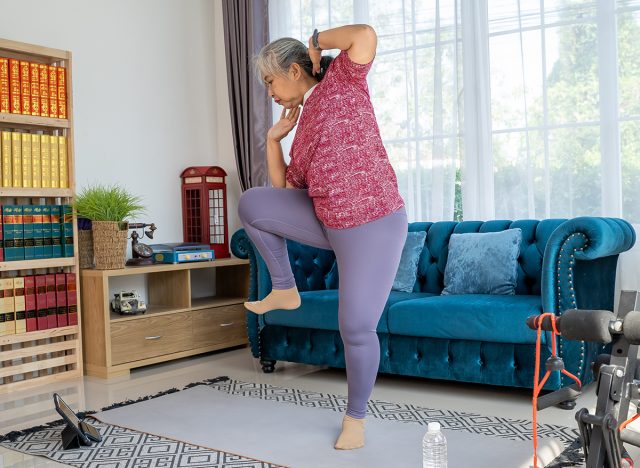
Standing exercises build muscle, and muscle is metabolically energetic tissue. Every bit of muscle you add or maintain increases the number of calories your body burns throughout the day, not just during exercise. This creates a compounding effect over weeks and months that cardio simply can’t match.
When you perform standing exercises that engage your core and work multiple muscle groups, your body has to stabilise itself constantly. Your abdominals, obliques, and deep core muscles all fire to keep you upright and balanced. This strengthens and tones the muscles around your waist in a way that walking never will.
There’s also the afterburn effect. Resistance training creates micro-tears in muscle fibres that your body then has to repair. That repair process burns calories for 24 to 48 hours after you finish exercising. Cardio doesn’t create the same level of metabolic demand once you’ve stopped moving.
Standing exercises are also practical and sustainable for older adults. You don’t need to get down on the floor and back up again repeatedly. You’re not putting stress on joints through high-impact movements. You can do these in your living room with minimal or no equipment, which means you’re more likely to stick with them long-term.
RELATED: If You Can Hold a Plank This Long After 60, Your Core Strength Is Stronger Than 90% of Peers
Standing Torso Rotation
This exercise directly works your obliques, the muscles on the sides of your waist that create definition and control rotation. When these muscles strengthen, they pull in your waistline and improve steadiness during everyday movements such as reaching or turning.
Muscles Trained: Obliques, deep core stabilisers
How to Do It:
- Stand with your feet hip-width apart and knees slightly bent
- Hold your arms out in front of you at chest height with your palms together
- Keep your hips facing forward
- Rotate your upper body to the right, turning as far as comfortable
- Return to centre, then rotate to the left
- Move smoothly and with control throughout
Recommended Sets and Reps: 15 to 20 rotations each side, working up to 3 sets
Common Mistakes to Avoid:
- Rotating from your hips instead of your waist; your hips should stay still and facing forward throughout
- Swinging your whole lower body, which removes the work from the obliques and risks straining your lower back.
Standing Side Bend
Side bends target the obliques and the muscles running along your sides. These muscles are often neglected in daily life, so strengthening them can greatly change your waist measurement and create a more defined shape.
Muscles Trained: Obliques, lateral trunk muscles
How to Do It:
- Stand with your feet shoulder-width apart
- Place your right hand on your hip and extend your left arm overhead
- Bend slowly to the right, sliding your right hand down your thigh while your left arm reaches over your head
- You should feel a stretch along your left side
- Return to the starting position and repeat on the other side
Recommended Sets and Reps: 12 to 15 bends each side for 2 to 3 sets
Common Mistakes to Avoid:
- Leaning forward or backward as you bend, which turns it into a different exercise and reduces effectiveness for the waist
- Moving out of one plane of movement; think of standing between two panes of glass and keeping your body flat against them throughout.
RELATED: The 7-Minute Standing Routine That Shrinks Hip Dip Fat After 45, According to a Trainer
Standing Knee to Elbow
This exercise combines core rotation with hip flexion, working both your obliques and your deeper abdominal muscles. It also improves balance and coordination, which becomes increasingly important after 60.
Muscles Trained: Obliques, deep abdominals, hip flexors
How to Do It:
- Stand with your feet hip-width apart and your hands behind your head
- Lift your right knee up and across your body while bringing your left elbow down to meet it
- Return to the starting position
- Repeat on the other side (left knee to right elbow)
Recommended Sets and Reps: Start with 10 to 12 reps per side for 2 sets; work up to 15 to 20 per side for 3 sets as you get stronger
Common Mistakes to Avoid:
- Rushing through the movement and barely lifting the knee; you want to bring your knee up as high as comfortable and really contract your core as your elbow comes down
- Treating it as a speed exercise; this is about feeling your muscles work, not getting through reps quickly
Standing Wood Chop
The wood chop movement engages your entire core through a diagonal rotation that mimics real-life movements. It works your obliques, rectus abdominis, and the stabilising muscles around your spine, all which add to a tighter waist.
Muscles Trained: Obliques, rectus abdominis, spinal stabilisers
How to Do It:
- Stand with your feet slightly wider than shoulder-width apart
- Clasp your hands together, or hold a light weight if you have one
- Start with your hands up near your right shoulder
- Sweep them down diagonally across your body toward your left hip, as if chopping wood
- Keep your arms relatively straight and let your torso rotate with the movement
- Return to the starting position and complete all reps on one side before switching
Recommended Sets and Reps: 12 to 15 chops each side for 2 to 3 sets
Common Mistakes to Avoid:
- Bending your back or hunching over as you chop down; the movement should come from rotating your torso while keeping your spine neutral
- Rounding your back, which puts unnecessary strain on it and removes the core engagement that makes this exercise effective.
RELATED: 4 Bed Exercises That Restore Thigh Strength Faster Than Leg Press After 65
Standing March with Twist
This exercise combines cardio with core work, getting your heart rate up slightly while specifically targeting your waist through rotation. The marching component also improves hip mobility and balance.
Muscles Trained: Obliques, hip flexors, core stabilisers
How to Do It:
- Stand tall with your hands behind your head
- March in place, lifting your knees high
- As your right knee comes up, rotate your upper body to bring your left elbow toward that knee
- As your left knee comes up, rotate to bring your right elbow toward it
- Keep marching and twisting in a rhythmic pattern
Recommended Sets and Reps: Start with 30 seconds to 1 minute of continuous marching with twists; work up to 2 to 3 minutes as your fitness improves
Common Mistakes to Avoid:
- Dropping your elbows forward instead of rotating your torso; your hands should stay behind your head throughout, with the rotation coming from your core
- Letting your chest drop or your back round; keep your chest lifted throughout.
How to Fit These Into Your Week
Start with 2 to 3 sessions per week, leaving at least one day between sessions for recovery. You can do all five exercises in one session, or split them up throughout the week assuming that feels more manageable.
A typical session: perform each exercise for the recommended reps or time, rest for 30 to 60 seconds between exercises, then repeat the circuit 2 to 3 times. The whole session shouldn’t take more than 15 to 20 minutes once you’re familiar with the movements.
You can do these on their own or add them to your existing walking routine. Some clients do their standing exercises in the morning and walk later in the day. Others prefer a short walk as a warm-up, then the exercises. There’s no single right way, just whatever helps you stick with it.
Check with your doctor before starting if you have uncontrolled high blood pressure, recent surgery (especially abdominal surgery), severe osteoporosis, significant balance problems, or any heart condition. If you experience sharp pain, dizziness, chest pain, or severe shortness of breath during these exercises, stop immediately and get medical advice.
Anyone with lower back issues should be particularly careful with the twisting movements. Disc problems, sciatica, or chronic back pain all warrant a conversation with your doctor or physiotherapist before beginning.
RELATED: 5 Dumbbell Exercises That Restore Shoulder Strength Faster Than Lifting Weights After 55
What to Expect After 4 to 6 Weeks
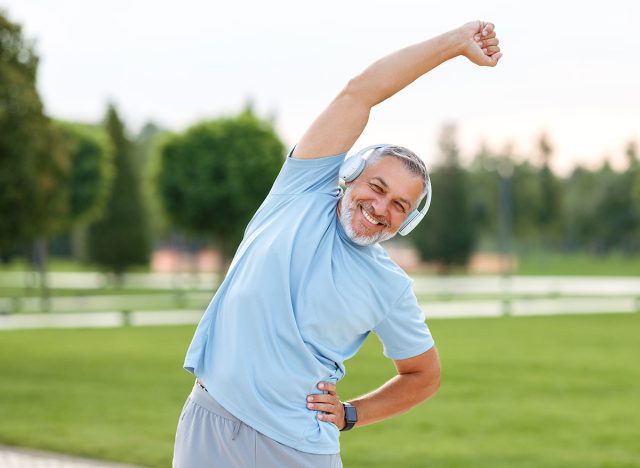
After 4 to 6 weeks of steady training, at minimum twice a week, you can expect your waist size to drop by 1 to 2 inches. For some it will be more, for some less, depending on your fitness level, diet, and how much visceral fat you carry.
The first signs you’ll notice aren’t in the mirror. You’ll feel better posture and stronger core muscles before you see any visual change. Your clothes will fit differently before you notice a drastic decrease in your waist measurement. Trousers that are now tight around the waist will loosen. You’ll stand taller without thinking about it.
Visual results aren’t only about losing fat; you’re also toning muscles. Even if you don’t lose as much weight as you expect, you’ll notice your waist is smaller and more defined as your abdominal muscles tighten and hold everything together.
Diet Matters More Than You Think

Diet is the single biggest factor in whether you see results. You can’t out-train a bad diet, no matter how consistently you train. If you’re consuming a lot more calories than your body burns, you’ll still build muscle underneath, but you won’t be able to see it through the body fat.
Most people who succeed make small adjustments rather than dramatic ones: less processed food, more protein and vegetables, less alcohol, and more awareness of portion sizes. The exercise builds the base. Your diet determines how much of that result becomes visible.
Frequency matters more than intensity. Training twice a week for six months will give you better results than training every day for three weeks and then stopping. Be consistent, be patient, and the results will come.
The post 5 Standing Exercises That Shrink Stubborn Waist Thickening Faster Than Cardio After 60 appeared first on Eat This Not That.
]]>The post The 7-Minute Standing Routine That Shrinks Hip Dip Fat After 45, According to a Trainer appeared first on Eat This Not That.
]]>Why Hip Dip Fat Is So Stubborn
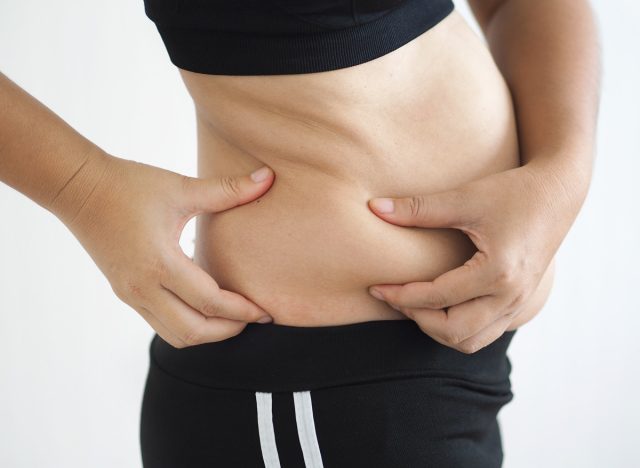
Hip dips are indentations between your hip bone and the top of your thigh. They’re completely normal and their visibility has nothing to do with fitness level. What people call “hip dip fat” is actually fat that sits around this area and becomes more noticeable as we age.
After 45, hormonal changes during perimenopause and menopause shift where your body stores fat. Oestrogen levels drop and your body starts storing more fat around your hips, thighs and lower abdomen. The fat cells in these areas also become more resistant to being broken down. Your metabolism slows by about 2–8% per decade after 40, which means your body burns fewer calories at rest.
The biggest mistake people make is thinking they can spot reduce this area. You cannot target fat loss in one specific part of your body. Doing hundreds of side leg lifts or hip abductions won’t burn the fat around your hip dips. Your body decides where it loses fat, and it’s largely determined by genetics and hormones.
The second mistake is focusing only on cardio. While cardio burns calories during the session, it doesn’t do much after you’ve finished. Women over 45 need to build and maintain muscle mass because we lose about 3–8% of our muscle per decade after 30. Less muscle means a slower metabolism, which means fewer calories burned throughout the day.
The third mistake is doing exercises lying down. Most floor exercises for hips don’t actually create enough resistance to stimulate real change. They might make the area feel like it’s working, but they’re not challenging enough to build muscle or burn significant calories.
RELATED: 4 Bed Exercises That Restore Thigh Strength Faster Than Leg Press After 65
Why Standing Beats Floor Work
Standing exercises work your entire body at once. When you’re on the floor doing leg lifts, you’re only moving one limb. When you’re standing, your core has to stabilise your torso, your supporting leg has to hold your weight, and your working leg has to move against gravity. This burns more calories and builds more muscle.
Standing exercises also improve your functional fitness. We don’t spend our daily lives on the floor doing leg lifts. We stand, we walk, we climb stairs, we reach for things. Training in standing positions makes you stronger for the movements you actually do, which means better balance and more confidence in daily activities.
For women over 45, standing work is also easier on your joints. Getting down and up from the floor repeatedly can be hard on knees and hips. Standing exercises let you work just as hard without that stress.
Standing routines build bone density better than floor work, too. Weight-bearing exercises send signals to your bones to stay strong — especially important after 45 when bone density naturally declines.
And standing exercises can be progressed more easily. You can add weights, change your stance width, increase your range of motion or adjust your speed. Floor exercises are much harder to increase in complexity once you’ve mastered them.
Side Step Squats
This exercise works your glutes, outer thighs and core while burning calories. The lateral movement targets the muscles around your hips, and the squat position engages your entire lower body.
Muscles Trained: Glutes, outer thighs, core
How to Do It:
- Stand with feet hip-width apart
- Step your right foot out to the side about two feet
- Bend both knees and push your hips back like you’re sitting into a chair
- Keep your chest up and your weight in your heels
- Push back to standing and bring your feet together
- Repeat on the left side, alternating for 90 seconds
Avoid These Mistakes:
- Don’t let your knees collapse inward — they should track in the same direction as your toes
- Don’t just drop straight down — your hips should move back and down, not just down
- Don’t rush through it — slow down and control the movement; you should feel your outer thighs and glutes working.
RELATED: 5 Dumbbell Exercises That Restore Shoulder Strength Faster Than Lifting Weights After 55
Standing Side Leg Raises with Pulse
This exercise directly works the muscles on the outside of your hip and thigh. The pulse at the top keeps the muscle under tension for longer, which builds strength and burns more calories.
Muscles Trained: Hip abductors, outer thighs
How to Do It:
- Stand tall with your feet together
- Shift your weight onto your left leg
- Lift your right leg out to the side about 12 inches off the ground
- At the top, pulse up and down in a small range (about 2 inches) for three pulses
- Lower your leg back down with control
- Do 45 seconds on each side
Avoid These Mistakes:
- Don’t lift your leg too high — this causes you to lean your torso to the opposite side, taking the work out of the target muscles and putting it into your lower back
- Don’t swing the leg — the movement should be controlled both up and down
- If you’re losing balance, hold onto a chair or wall with one hand.
Curtsy Lunges
Curtsy lunges work your glutes from a different angle than regular lunges. They also challenge your balance and work your inner and outer thighs at the same time.
Muscles Trained: Glutes, inner thighs, outer thighs
How to Do It:
- Stand with feet hip-width apart
- Step your right foot back and across behind your left leg like you’re doing a curtsy
- Bend both knees and lower down until your back knee is close to the floor
- Keep your front knee over your front ankle
- Push through your front heel to stand back up
- Alternate legs for 90 seconds
Avoid These Mistakes:
- Don’t let your front knee cave inward — keep it aligned with your toes
- Don’t step back too narrowly — the wider you step, the more you’ll work your glutes
- Don’t lean forward — keep your chest up and your core engaged
- If you’re struggling with balance, reduce your range of motion or hold onto something until you build strength.
RELATED: 5 Daily Exercises That Restore Full-Body Strength Faster Than Gym Sessions After 60
Lateral Step Ups
This exercise combines strength and cardio. It works your glutes, thighs and core while getting your heart rate up. The stepping motion also improves your functional fitness for stairs.
Muscles Trained: Glutes, quads, hamstrings, core
How to Do It:
- Stand next to a sturdy step or box about knee height
- Place your right foot on the step
- Push through your right heel to lift your body up onto the step
- Bring your left foot up to meet your right
- Step back down with your left foot first, then your right
- Do 45 seconds leading with your right leg, then 45 seconds leading with your left
Avoid These Mistakes:
- Don’t push off with your bottom foot — the work should come from the leg on the step, not the leg on the ground
- Don’t use momentum — control the movement both up and down
- Don’t start with a step that’s too high — begin lower and progress as you get stronger; if your knee comes past your toes at the bottom, the step is too high.
Standing Hip Circles
This exercise works your hips through their full range of motion. It strengthens the muscles around your hip joint and improves mobility, which tends to decrease after 45.
Muscles Trained: Hip flexors, glutes, hip abductors and adductors
How to Do It:
- Stand on your left leg with your right leg lifted slightly off the ground
- Draw circles in the air with your right knee, making them as large as you can control
- Do 45 seconds clockwise, then 45 seconds anticlockwise
- Switch legs
Avoid These Mistakes:
- Don’t make the circles too small — challenge yourself to make them larger while keeping your torso stable
- Don’t let your hips shift around — your standing hip should stay stacked over your ankle
- Don’t hold your breath — keep breathing normally throughout
- Hold onto a wall or chair if you need support for balance.
RELATED: 5 Park Bench Exercises That Restore Leg Muscle Faster Than Squats After 60
How to Structure Your Routine
Do this routine as a circuit, moving from one exercise straight into the next with no rest between exercises. This keeps your heart rate up and burns more calories in a short time.
Start with a brief warmup: march in place for 30 seconds, do some arm circles and a few gentle hip rotations. This gets blood flowing to your muscles and reduces injury risk.
Work through all five exercises in order. The total work time is 7.5 minutes. After you finish the last exercise, walk around for 30 seconds to a minute to bring your heart rate down gradually. Don’t sit down immediately.
Do this routine 4–5 times per week for the best results. Your body needs rest days to recover and build muscle. Three times per week is the minimum to see changes, but more frequent sessions will give you faster results.
You can do this routine on its own or add it to the end of a walk. It works well as a finisher after cardio, or on days when you’re doing upper body work.
After about four weeks of consistent training, progress the routine. Add light ankle weights or small dumbbells, increase your range of motion on each exercise, move more slowly to increase time under tension, or add an extra round of the circuit if you have time.
What Results to Expect
In the first two weeks, you won’t notice any visual results — but you will feel the difference. The workouts will become easier, your balance will improve, and you’ll feel more energised throughout the day. That’s how you’ll know your muscles are getting stronger.
After a month, you might notice your pants sitting slightly better on your hips and thighs. The area will feel a bit tighter when you press on it. Going up the stairs or getting in and out of your car will probably become easier, and your posture will likely improve without you even noticing.
After two months, other people will probably start to notice that you look different. Your lower body will be taking shape, your hips and thighs will be more toned, and the fat around the hip dips will feel tighter. With consistent exercise and managed nutrition, some fat loss around the area is realistic.
After three months, you’ll start to notice an actual change in muscle tone. Your legs will be stronger, your balance will have improved markedly, and the muscles around your hips will be strong enough to make the hip dips less noticeable — even if they’re still there.
Keep in mind that hip dips are part of your bone structure. Results will vary from woman to woman. The goal isn’t to remove a part of your anatomy that’s meant to be there — it’s to strengthen your muscles and reduce the fat around the area. Some women will notice significant results, others moderate results. Either way, if you’re stronger and healthier than when you started, that’s a real win.
RELATED: The 6-Minute Bed Routine That Restores Full-Body Balance After 65
The Nutrition Factor

You cannot out-exercise a bad diet. This 7-minute workout burns around 50–70 calories — less than a small banana. Exercise will make you more muscular and fitter, but it won’t remove fat on its own. To lose fat around your hip dips, or anywhere else, you need to be in a calorie deficit. That means consuming slightly fewer calories than your body uses each day. A deficit of 300–500 calories per day will result in a slow and sustainable loss of around 0.5–1lb per week.
Once you’re over 45, you need more protein. Aim for around 0.8–1g of protein per lb of body weight per day. Protein helps you maintain or even build muscle, which keeps your metabolism higher. It also keeps you full, making it easier to stay in a deficit. Good sources include lean meats, fish, eggs, Greek yoghurt, cottage cheese and legumes.
Cut down on processed foods and added sugars. They provide a lot of calories for very little nutrition and they won’t keep you full. Focus instead on whole foods — vegetables, fruits, whole grains, lean proteins and healthy fats. They provide more nutrition per calorie and will keep your energy levels more stable.
Drink plenty of water. Sometimes you can feel hungry when you’re actually just thirsty. Aim for around 2 litres per day, more if you’re exercising or it’s hot.
Don’t cut your calories too low. This will slow your metabolism, cause you to lose muscle alongside fat, and leave you feeling tired and irritable — which you won’t be able to sustain long term. A moderate deficit you can stick to is always better than a severe one you can’t.
Fat loss isn’t always linear. Some weeks you’ll notice changes and some weeks you won’t. All that matters is the trend over months, not over any given week. Consistency is everything — with both exercise and nutrition.
The post The 7-Minute Standing Routine That Shrinks Hip Dip Fat After 45, According to a Trainer appeared first on Eat This Not That.
]]>The post 5 Standing Exercises That Shrink Waist Overhang Faster Than Weight Training After 60 appeared first on Eat This Not That.
]]>Over years of coaching, I’ve seen a clear pattern in exercises that help people feel leaner and stronger through the waist. Movements that recruit the legs, hips, and upper body simultaneously naturally raise heart rate and encourage the body to burn more energy. At the same time, the core has to stay engaged to keep everything stable. That combination often delivers far more return than isolated midsection work.
The five standing exercises below tap into that full-body effect. They keep the body moving, activate major muscle groups, and challenge the core from start to finish. Perform them consistently, and you’ll build strength, increase calorie burn, and support the kind of training that helps reduce waist overhang over time.
High Knees
High knees combine core engagement with quick lower-body movement. Each time the knee drives upward, the abdominals and hip flexors work together to stabilize the torso. The fast tempo also increases heart rate and encourages greater calorie burn. Many people notice their core automatically bracing to keep the body upright. Over time, this movement helps strengthen the midsection while improving coordination and conditioning.
Muscles Trained: Hip flexors, lower abdominals, quads, and calves.
How to Do It:
- Stand tall with your feet hip-width apart.
- Begin jogging in place.
- Drive one knee upward toward your chest.
- Quickly switch legs while maintaining a steady rhythm.
- Continue alternating knees at a controlled pace.
Recommended Sets and Reps: Perform 3 sets of 30 seconds. Rest for 30 seconds between each set.
Best Variations: Slow high knees, marching high knees, band-resisted high knees.
Form Tip: Keep your chest tall and drive your knees upward rather than leaning back.
RELATED: 4 Bed Exercises That Shrink Stubborn Midsection Faster Than Ab Workouts After 60
Jumping Jacks
Jumping jacks are a classic movement for a reason. They involve the entire body while encouraging continuous motion. The arms and legs move together, which forces the core to stabilize the torso throughout the exercise. This combination quickly raises heart rate and increases overall energy output. When performed consistently, jumping jacks help strengthen the core while improving endurance.
Muscles Trained: Shoulders, hips, calves, and core.
How to Do It:
- Stand with your feet together and your arms at your sides.
- Jump your feet outward while raising your arms overhead.
- Land softly with your knees slightly bent.
- Jump your feet back together while lowering your arms.
- Continue repeating the motion in a steady rhythm.
Recommended Sets and Reps: Perform 3 sets of 30 seconds. Rest for 30 seconds between each set.
Best Variations: Low-impact step jacks, slow jumping jacks, power jacks.
Form Tip: Land softly and maintain a steady rhythm throughout the movement.
Medicine Ball Slams
Medicine ball slams combine power, coordination, and full-body engagement. The downward slam activates the core while the hips and shoulders generate force. This explosive movement encourages the entire body to work together. Because the exercise recruits large muscle groups, it also increases calorie expenditure. Over time, slams help strengthen the muscles that wrap around the waist.
Muscles Trained: Core, shoulders, lats, and hips.
How to Do It:
- Stand with your feet shoulder-width apart while holding a medicine ball.
- Raise the ball overhead with both hands.
- Brace your core and slam the ball toward the floor.
- Catch or retrieve the ball as it rebounds.
- Reset and repeat the movement.
Recommended Sets and Reps: Perform 3 sets of 10 to 12 reps. Rest for 45 seconds between each set.
Best Variations: Rotational slam, alternating slam, overhead slam.
Form Tip: Engage your core before slamming the ball downward.
RELATED: The 5-Minute Standing Routine That Restores Posture After 60, According to a Trainer
Squat Jumps
Squat jumps train the legs and core while encouraging explosive power. Lowering into the squat activates the quads and glutes, while the jump requires the body to produce force quickly. The core works to stabilize the torso during both the jump and the landing. This combination challenges the entire lower body while increasing energy output. With regular practice, squat jumps help build strength and conditioning simultaneously.
Muscles Trained: Quads, glutes, calves, and core.
How to Do It:
- Stand with your feet shoulder-width apart.
- Lower your body into a squat position.
- Drive through your feet and jump upward.
- Land softly with your knees slightly bent.
- Reset your stance and repeat.
Recommended Sets and Reps: Perform 3 sets of 8 to 10 reps. Rest for 60 seconds between each set.
Best Variations: Pause squat jump, low-impact squat jump, box squat jump.
Form Tip: Land softly and absorb the impact through your hips and knees.
Suitcase Carry
The suitcase carries the challenge of the core in a subtle yet powerful way. Holding weight on one side forces the abdominal muscles to stabilize the torso, preventing leaning. This creates continuous tension through the obliques and deep core muscles. Walking while holding the weight also recruits the hips and shoulders. Over time, suitcase carrying helps strengthen the muscles that support the waistline and improve posture.
Muscles Trained: Obliques, core stabilizers, shoulders, and grip.
How to Do It:
- Hold a dumbbell or kettlebell in one hand at your side.
- Stand tall with your shoulders level.
- Brace your core and begin walking forward.
- Maintain steady steps and an upright posture.
- Switch hands after completing the distance.
Recommended Sets and Reps: Perform 3 sets of 30 to 40 seconds per side. Rest for 45 seconds between each set.
Best Variations: Farmer carry, front rack carry, kettlebell carry.
Form Tip: Keep your shoulders level and avoid leaning toward the weight.
RELATED: 4 Standing Exercises That Restore Thigh Strength Faster Than Squats After 60
Best Daily Habits That Help Reduce Waist Overhang After 60

Reducing waist overhang becomes easier when exercise works alongside supportive daily habits. Strength training and movement increase energy output while helping the body maintain muscle mass. When combined with healthy lifestyle choices, these habits encourage the body to gradually reduce excess fat.
- Train large muscle groups regularly: Full-body movements increase energy expenditure and stimulate more muscle.
- Stay consistent with movement: Daily activity helps maintain calorie burn throughout the week.
- Prioritize protein intake: Protein supports muscle maintenance while encouraging satiety.
- Support workouts with sleep and recovery: Quality sleep helps regulate hormones that influence body composition.
- Maintain a balanced routine: Combining strength, movement, and healthy habits encourages long-term results.
References
- Donnelly, Joseph E et al. “Aerobic exercise alone results in clinically significant weight loss for men and women: midwest exercise trial 2.” Obesity (Silver Spring, Md.) vol. 21,3 (2013): E219-28. doi:10.1002/oby.20145
- Cox, Carla E. “Role of Physical Activity for Weight Loss and Weight Maintenance.” Diabetes spectrum : a publication of the American Diabetes Association vol. 30,3 (2017): 157-160. doi:10.2337/ds17-0013
The post 5 Standing Exercises That Shrink Waist Overhang Faster Than Weight Training After 60 appeared first on Eat This Not That.
]]>The post The 5-Minute Standing Routine That Restores Posture After 60, According to a Trainer appeared first on Eat This Not That.
]]>Now that you’re probably straightening your back while reading this, we’re here with something better. We spoke with Corryne Hart, BASI Pilates, NCPT, Club Pilates Master Trainer, who shares a five-minute standing routine you can try that restores posture after 60.
“As we get older, it’s common for posture to change because the muscles that support our spine naturally lose strength. Spinal discs start to shrink and joints can stiffen, which often leads to a rounded upper back and forward head. The good news is that gentle movement, like Pilates, can help strengthen muscles, improve mobility, and help the body stand taller and feel more supported,” Hart tells us. “Even just a few minutes of standing Pilates each day can make a big difference in improving posture. These exercises engage your whole postural system, from your feet and legs to your glutes, core, and back, helping your body relearn how to support itself while upright.”
Below, Hart breaks down a five-minute workout that helps restore posture after 60. Have a sturdy chair nearby to hold onto for balance. Begin each exercise with your feet hip-distance apart, gently tighten your midsection, and roll your shoulders back and down.
Standing Chest Expansion
- From the start position, bring your arms slightly behind your body with your palms facing back.
- Breathe out as you press your arms back, lift through the chest, and draw your shoulders back and down.
- Breathe in to release your hands forward.
- Repeat for 10 reps.
RELATED: 5 Easy Bodyweight Tests That Show Your Real Fitness After 45
Standing Leg Raises
- From the start position, bring your arms out to form a “T” position and pull your ribs in.
- Shift your body weight onto one leg, softening into your knee.
- Breathe out to lift the opposite leg slightly out to the side.
- Inhale as you return the leg back to the start position.
- Exhale to lift the leg slightly behind you.
- Alternate between the two movements 10 times before switching sides. Maintain a steady, upright torso.
RELATED: These 5 Daily Moves Reverse Muscle Loss Faster Than Gym Workouts After 45
Heel Raises With Arm Lifts
- From the start position, bring your arms out to form a “T” as you gently pull your ribcage in.
- Breathe out and lift your heels off the ground.
- Lower your heels with control.
- Repeat 10 times.
RELATED: If You Can Do These 3 Balance Tests at 60, Your Body Age Is 20 Years Younger
Side Bends
- From the start position, interlace your hands behind your head as you gently pull your ribcage in.
- Exhale and bend gently to one side, reaching your elbow toward the ground.
- Inhale as you return to standing.
- Alternate sides and repeat 10 times on each side.
RELATED: If You Can Hold a Plank This Long After 50, Your Core Is Stronger Than Most
Spine Twist With Knee Raise
- From the start position, interlace your hands behind your head and gently pull your ribcage in.
- Rotate your torso a few inches to one side, then pause.
- Lift the same-side knee in a gentle marching motion.
- Inhale as you return your foot to the floor.
- Untwist back to the center.
- Repeat 10 times before switching sides.
The post The 5-Minute Standing Routine That Restores Posture After 60, According to a Trainer appeared first on Eat This Not That.
]]>The post 4 Standing Exercises That Restore Thigh Strength Faster Than Squats After 60 appeared first on Eat This Not That.
]]>“After 60, muscle loss accelerates due to sarcopenia, the age-related decline in muscle mass and strength. Adults can lose 3–8% of muscle mass per decade, and the rate often increases in the 60s and beyond,” explains Karen Ann Canham, CEO and founder of Karen Ann Wellness, Board-Certified Wellness Coach, and Nervous System Specialist who has almost two decades of experience in wellness and corporate leadership. “Hormonal shifts, reduced activity levels, and changes in neuromuscular signaling all contribute. The body also loses fast-twitch muscle fibers, which are responsible for power and quick reactions.”
Because your thighs house some of the biggest and most essential muscles in the entire body, weakness in this area can majorly impact mobility.
“Declining thigh strength can make everyday movements—like climbing stairs, standing up from a chair, walking long distances, or catching yourself during a loss of balance—much more difficult,” Canham tells us. “Maintaining strong thigh muscles is strongly linked to fall prevention, walking speed, and long-term independence.”
Below, Canham shares four standing exercises that can help restore thigh strength quicker than squats after 60.
Stair Step-Ups
- Begin by standing tall, facing a low step. Hold an optional lightweight dumbbell in each hand.
- Place your left foot firmly onto the surface, keeping your core engaged and chest tall.
- Press through your left heel to lift your body until your left leg is straight and you’re standing on the surface.
- Use control to lower back to the start position.
- Repeat on the other side.
- Perform 2 to 3 sets of 8 to 10 reps on each leg.
RELATED: 5 Easy Bodyweight Tests That Show Your Real Fitness After 45
Reverse Lunges
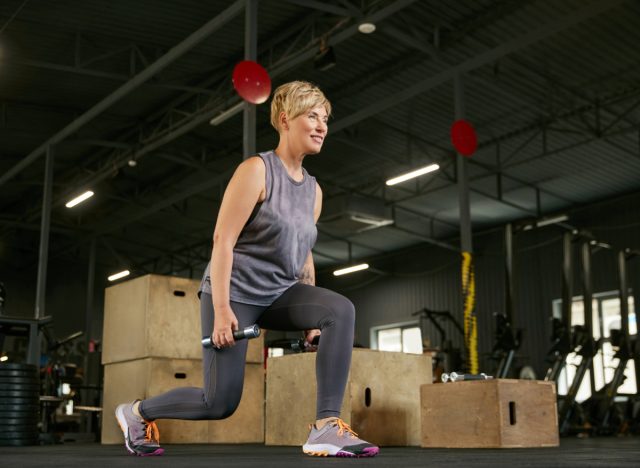
- Stand tall with your feet hip-distance apart and arms at your sides, holding a dumbbell in each hand.
- Step your left foot back a few feet, making sure to land on the ball of your foot.
- Lower into a lunge position until your front thigh is parallel to the ground and your back knee hovers just above the floor.
- Press through your front heel to rise back up to standing.
- Perform 2 to 3 sets of 8 to 10 reps on each leg.
RELATED: These 5 Daily Moves Reverse Muscle Loss Faster Than Gym Workouts After 45
Lateral Band Walks
- Begin by placing a resistance band around your ankles or thighs.
- Slightly bend your knees and step sideways, keeping your movement controlled.
- Perform 2 to 3 sets of 10 to 12 steps in each direction.
RELATED: If You Can Do These 3 Balance Tests at 60, Your Body Age Is 20 Years Younger
Supported Split Squats
- Start by standing tall holding onto a sturdy chair or wall for support.
- Step your left foot forward about 2 to 3 feet to assume a staggered stance.
- Bend both knees, lowering the bottom toward the ground.
- Press through your front heel to rise back up.
- Perform 2 to 3 sets of 8 to 10 reps on each leg.
The post 4 Standing Exercises That Restore Thigh Strength Faster Than Squats After 60 appeared first on Eat This Not That.
]]>The post 5 Standing Exercises That Restore Glute Strength Faster Than Squats After 60 appeared first on Eat This Not That.
]]>Squats tend to shift workload toward the quadriceps if posture, depth, or hip engagement isn’t correct. That’s why I frequently introduce standing exercises that directly target the glutes while reducing knee strain. These movements allow people to focus on squeezing and activating the glute muscles rather than simply moving up and down through a squat pattern.
Another benefit of standing glute exercises involves functional carryover. Because these movements happen in an upright position, the muscles strengthen in the same posture used for walking, balancing, and climbing stairs. When clients train the glutes this way consistently, they often regain strength and stability faster than they do with traditional squatting routines alone.
The following standing exercises focus on activating the glutes from multiple angles while keeping the joints comfortable. Perform each movement slowly and concentrate on squeezing the glute muscles during every repetition. Over time, these exercises help restore the strength and power that keep the body moving confidently.
RELATED: 5 Daily Exercises That Restore Hip Mobility Faster Than Floor Stretches After 55
Standing Hip Extensions
Standing hip extensions directly target the gluteus maximus, the largest muscle responsible for pushing the leg backward and propelling the body forward during walking. I often start clients with this movement because it isolates the glutes without requiring complicated coordination or heavy resistance.
Extending the leg behind the body forces the glutes to contract while the hips remain stable. Many clients quickly realize how little these muscles were working during their previous workouts. With consistent practice, the glutes begin firing more naturally during everyday activities.
How to Do It
- Stand tall while holding a chair for balance
- Extend one leg straight behind you
- Squeeze the glutes at the top
- Lower the leg slowly
- Alternate legs steadily.
Standing Kickbacks
Kickbacks strengthen the glutes through a slightly larger range of motion than basic hip extensions. I frequently use this movement once clients become comfortable activating their glute muscles.
The key involves keeping the torso upright while moving only the leg. When performed slowly, the glutes remain under tension throughout the lift and the return. This continuous engagement helps rebuild muscle endurance and strength.
How to Do It
- Stand tall with hands on a chair
- Lift one leg backward in a controlled motion
- Keep the knee slightly bent
- Squeeze the glutes at the top
- Lower slowly and switch legs.
RELATED: If You Can Hold These 3 Bed Positions After 60, Your Core Is Stronger Than 90% of Peers
Standing Side Leg Raises
Side leg raises activate the gluteus medius, a smaller but extremely important muscle that stabilizes the hips during walking and balancing. Weakness here often leads to hip instability and lower back discomfort.
I include this movement in nearly every glute-strength routine because it strengthens the muscles that keep the pelvis level while the body moves. Many clients notice improved balance after just a few weeks of practice.
How to Do It
- Stand tall beside a chair
- Lift one leg out to the side
- Keep the torso upright
- Lower the leg slowly
- Repeat and switch sides.
Step-Back Toe Taps
Step-back toe taps strengthen the glutes while improving balance and coordination. This exercise mimics the backward hip motion used during walking and stepping, making it highly functional.
I often add this movement because it forces the glutes to control both the backward step and the return to standing. The muscles remain engaged throughout the entire movement, building strength and stability simultaneously.
How to Do It
- Stand tall with feet hip-width apart
- Step one foot backward and tap the floor
- Return to the starting position
- Keep your torso upright
- Alternate legs steadily.
RELATED: 5 Bed Exercises That Restore Leg Strength Faster Than Squats After 60
Standing Glute Squeeze
The standing glute squeeze may look simple, but it teaches the body how to fully activate the glute muscles. Many people lose the ability to contract these muscles strongly over time, which limits strength during other exercises.
I often use this movement as a finishing drill because it reinforces strong glute engagement. When clients learn to contract these muscles deliberately, other lower-body exercises become far more effective.
How to Do It
- Stand tall with feet hip-width apart
- Tighten both glute muscles firmly
- Hold the contraction for a few seconds
- Relax briefly
- Repeat several times.
The post 5 Standing Exercises That Restore Glute Strength Faster Than Squats After 60 appeared first on Eat This Not That.
]]>The post 5 Standing Exercises That Flatten Stubborn Belly Pooch Faster Than Crunches After 55 appeared first on Eat This Not That.
]]>That’s where standing exercises shine. Movements that involve the hips, legs, and upper body simultaneously elevate heart rate, stimulate more muscle groups, and increase calorie output. I’ve seen this approach work well with many clients over 55 who want workouts that feel productive without demanding hours in the gym. Big compound movements help the body work harder while also strengthening the core muscles that support the midsection.
The exercises below combine strength and movement to create a potent training effect. Each one recruits large muscle groups while keeping the core active and stable. Perform them regularly, and you’ll build strength, increase calorie burn, and support training that helps flatten stubborn belly pooch.
RELATED: 4 Standing Exercises That Restore Stair-Climbing Strength Faster Than Lunges After 60
Side Slams
Side slams combine rotation, power, and full-body engagement in a single movement. The explosive downward slam activates the obliques while the legs and hips generate force. That combination challenges the core while elevating heart rate and increasing calorie burn. Rotational exercises also strengthen the muscles that wrap around the waistline. Over time, stronger obliques help support a tighter midsection.
Muscles Trained: Obliques, shoulders, core, and hips.
How to Do It:
- Stand with your feet shoulder-width apart while holding a medicine ball.
- Raise the ball above one shoulder.
- Rotate your torso as you slam the ball down toward the opposite side.
- Catch or retrieve the ball and reset your position.
- Repeat the movement on the opposite side, switching each rep.
Recommended Sets and Reps: Perform 3 sets of 10 to 12 reps per side. Rest for 45 seconds between each set.
Best Variations: Rotational slam, overhead slam, alternating slam.
Form Tip: Rotate through your torso while keeping your feet planted and your core braced.
Kettlebell High Pulls
Kettlebell high pulls train explosive hip extension while challenging the upper body and core. The powerful hip drive recruits large muscle groups in the glutes and legs. As the kettlebell travels upward, the core stabilizes the torso to control the movement. This type of full-body effort increases energy output and strengthens multiple muscle groups at once. Consistent practice builds strength and supports fat loss efforts.
Muscles Trained: Glutes, hamstrings, shoulders, and core.
How to Do It:
- Stand with your feet shoulder-width apart, holding a kettlebell in both hands.
- Hinge your hips back and allow the kettlebell to swing between your legs.
- Drive your hips forward powerfully.
- Pull the kettlebell upward toward chest height.
- Lower the kettlebell with control and repeat.
Recommended Sets and Reps: Perform 3 sets of 10 to 12 reps. Rest for 60 seconds between each set.
Best Variations: Single-arm high pull, kettlebell swing-to-high pull, alternating high pull.
Form Tip: Generate the movement from your hips rather than pulling with your arms.
RELATED: 5 Exercises You Can Do in Your Bedroom That Restore Full-Body Strength After 60
Dumbbell Squat to Press
The dumbbell squat-to-press combines two compound movements into a powerful exercise. The squat activates the legs and glutes while the press challenges the shoulders and core. This full-body effort increases muscle recruitment and calorie expenditure. The core remains active throughout the entire movement to stabilize the spine. Over time, this exercise strengthens the entire body while supporting fat-burning workouts.
Muscles Trained: Quads, glutes, shoulders, and core.
How to Do It:
- Hold a dumbbell in each hand at shoulder height.
- Stand with your feet shoulder-width apart.
- Lower into a squat while keeping your chest upright.
- Drive upward through your heels.
- Press the dumbbells overhead as you stand.
Recommended Sets and Reps: Perform 3 sets of 8 to 10 reps. Rest for 60 seconds between each set.
Best Variations: Single-dumbbell thruster, kettlebell thruster, alternating press thruster.
Form Tip: Brace your core before pressing the weights overhead.
Step-Ups
Step-ups strengthen the lower body while increasing heart rate and overall workload. Each step challenges the glutes and quads while the core stabilizes the body during the movement. This combination improves lower-body strength and contributes to higher calorie expenditure. The movement also mimics everyday activities such as climbing stairs. Over time, step-ups build strength and endurance while supporting fat-burning workouts.
Muscles Trained: Quads, glutes, hamstrings, and core.
How to Do It:
- Stand in front of a sturdy bench or step.
- Place one foot firmly on top of the platform.
- Drive through that foot to lift your body upward.
- Briefly bring the opposite foot onto the platform.
- Step back down with control and repeat.
Recommended Sets and Reps: Perform 3 sets of 10 reps per leg. Rest for 60 seconds between each set.
Best Variations: Weighted step-ups, alternating step-ups, knee-drive step-ups.
Form Tip: Push through your front heel to activate the glutes.
RELATED: 5 Daily Exercises Men Over 55 Should Do to Restore Lost Muscle
Kettlebell Swing
Kettlebell swings train explosive hip movement while engaging the entire posterior chain. The glutes and hamstrings drive the motion while the core stabilizes the spine. This repeated full-body effort elevates heart rate and increases calorie burn. Swings also strengthen the muscles that support posture and athletic movement. With consistent training, they become one of the most efficient exercises for building strength and energy output.
Muscles Trained: Glutes, hamstrings, core, and lower back stabilizers.
How to Do It:
- Stand with your feet slightly wider than shoulder width.
- Hold a kettlebell with both hands in front of your hips.
- Hinge your hips back and swing the kettlebell between your legs.
- Drive your hips forward to propel the kettlebell to chest height.
- Allow the kettlebell to swing back down and repeat.
Recommended Sets and Reps: Perform 3 sets of 12 to 15 reps. Rest for 60 seconds between each set.
Best Variations: Single-arm swing, alternating swing, heavy power swing.
Form Tip: Snap your hips forward and keep your core braced during each swing.
RELATED: 5 Standing Exercises That Reduce Waist Thickening Faster Than Cardio After 55
Daily Habits That Help Flatten Belly Pooch After 55

Shrinking a belly pooch becomes much easier when exercise is paired with supportive daily habits. Training stimulates muscles and increases energy output, yet long-term fat loss also depends on lifestyle factors. When strength training, nutrition, and recovery align, the body becomes far more efficient at maintaining a healthy body composition.
- Create a small calorie deficit: Fat loss occurs when the body consistently burns more calories than it consumes.
- Prioritize protein intake: Protein supports muscle maintenance and helps keep you satisfied between meals.
- Train large muscle groups regularly: Exercises that involve the legs, hips, and upper body increase calorie expenditure.
- Stay consistent with movement: Daily walks and regular workouts help maintain energy output throughout the week.
- Prioritize sleep and recovery: Adequate sleep supports hormonal balance and overall metabolic health.
Combine these habits with the exercises above, and you’ll create a routine that supports a stronger body and a tighter midsection.
References
- Brobakken, Mathias Forsberg et al. “Abdominal aerobic endurance exercise reveals spot reduction exists: A randomized controlled trial.” Physiological reports vol. 11,22 (2023): e15853. doi:10.14814/phy2.15853
- Saeidifard, Farzane et al. “Differences of energy expenditure while sitting versus standing: A systematic review and meta-analysis.” European journal of preventive cardiology vol. 25,5 (2018): 522-538. doi:10.1177/2047487317752186
The post 5 Standing Exercises That Flatten Stubborn Belly Pooch Faster Than Crunches After 55 appeared first on Eat This Not That.
]]>