The post The 7-Minute Standing Routine That Restores Core Strength Faster Than Floor Exercises After 60 appeared first on Eat This Not That.
]]>The core doesn’t just function on the floor, it works hardest while you’re upright, stabilizing your body during walking, reaching, and balancing. That’s why standing exercises often restore real-world core strength faster than traditional crunches or planks. When you train the core in a standing position, you teach it to support your body exactly the way it needs to during daily life.
This 7-minute routine focuses on continuous tension, posture control, and deliberate movement. Each exercise lasts just over two minutes, keeping the core engaged without rest. Stay tall, brace your midsection, and move with purpose. When done consistently, this routine rebuilds deep core strength that carries into everything you do.
RELATED: 5 Exercises Personal Trainers Recommend for Clients Over 60 Who Haven’t Worked Out in Years
Minutes 0–2:30 — Standing Knee Drive Hold
This movement locks in lower-core activation while challenging balance and posture. I use this often with clients who need to rebuild coordination and abdominal strength at the same time. Holding the knee at the top forces the core to stabilize the entire body, which creates deep engagement through the lower abs and hip flexors. When done correctly, you’ll feel the midsection working far more than during most floor exercises.
Maintaining an upright posture becomes critical here. As fatigue builds, the body wants to lean back or collapse forward. Resist that urge and keep your torso tall. That’s where the real strength develops.
How to Do It
- Stand tall with feet hip-width apart
- Lift one knee to hip height
- Hold for 2–3 seconds
- Keep core tight and posture upright
- Lower slowly and switch sides.
Minutes 2:30–5:00 — Standing Cross-Body Crunch
This exercise targets the entire abdominal wall while emphasizing rotational strength. I rely on this movement because it builds the kind of core control needed for everyday activities like turning, reaching, and walking. Bringing the elbow and knee together forces the obliques and lower abs to fire together.
Controlled movement makes all the difference. Fast reps reduce effectiveness. Slow, deliberate crunches create constant tension and better muscle activation. As the pace stays steady, the core remains fully engaged throughout the entire interval.
How to Do It
- Stand tall with hands behind your head
- Lift one knee across your body
- Bring opposite elbow toward the knee
- Return to start slowly
- Alternate sides continuously.
RELATED: 5 Standing Exercises That Build Walking Endurance Faster Than Treadmills After 65
Minutes 5:00–7:00 — Standing Anti-Rotation Hold (Hands Press)
This final movement builds deep core stability by resisting movement rather than creating it. I use anti-rotation drills frequently because they strengthen the muscles that keep the spine stable during everyday motion. Instead of bending or twisting, the goal here involves holding tension and preventing rotation.
Press your hands together firmly in front of your chest and maintain that pressure. As you hold, your core fires to keep your torso stable. It may look simple, but when done with intent, this exercise creates deep, lasting core engagement.
How to Do It
- Stand tall with feet shoulder-width apart
- Press palms together in front of chest
- Tighten your core muscles
- Hold steady tension
- Breathe slowly while maintaining posture.
The post The 7-Minute Standing Routine That Restores Core Strength Faster Than Floor Exercises After 60 appeared first on Eat This Not That.
]]>The post If You Can Hold a Bridge This Long After 55, Your Core Strength Is Top-Tier appeared first on Eat This Not That.
]]>Strong glutes and hips play a huge role in how the body performs as it ages. They drive powerful movements like climbing stairs, walking uphill, and rising from chairs. They also help stabilize the pelvis so the lower back doesn’t absorb unnecessary stress. When those muscles stay strong and coordinated, everyday movement feels smoother and more confident.
Hip strength also supports long-term joint health. The glutes help control the position of your knees and spine during movement. That control improves balance, reduces strain on surrounding joints, and keeps your body aligned during walking, lifting, and other daily activities. Many coaches consider the glutes one of the most important muscle groups for maintaining mobility later in life.
The bridge hold offers a clear way to test how well those muscles are doing their job. Holding the position requires your glutes, hamstrings, and deep core muscles to work together without losing tension. Up next, you’ll learn why the bridge is such an effective functional movement, how to perform it correctly, what your hold time says about your core strength, and how to build even stronger hips and glutes.
RELATED: 5 Bed Exercises That Flatten Stubborn Midsection Faster Than Crunches After 60
Why the Bridge Is a Functional Movement
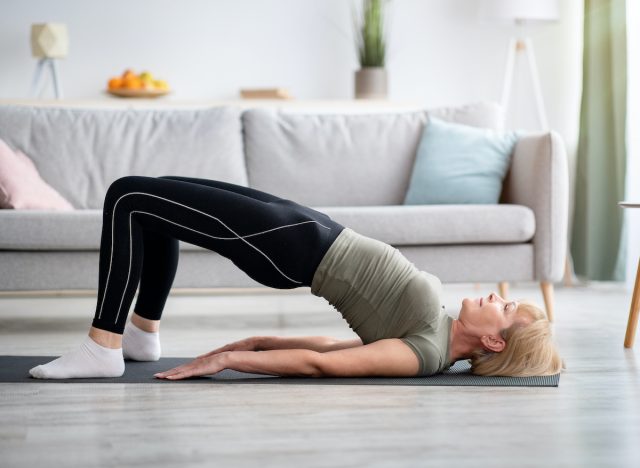
The bridge reinforces one of the body’s most important movement patterns: hip extension. Every step you take, every stair you climb, and every time you stand up from a seated position relies on your hips extending powerfully and under control. Training that pattern helps maintain strength in movements you perform dozens of times every day.
The bridge also teaches your body how to separate hip movement from lower-back movement. Many adults begin to rely too heavily on their lower back when their glutes weaken. The bridge encourages the glutes to take the lead again, improving spinal support and reducing unnecessary strain on the lumbar region.
Another advantage of the bridge is how effectively it challenges muscular endurance. Holding the position forces your glutes and deep core muscles to maintain tension while your pelvis stays level. That sustained effort builds fatigue resistance in the muscles responsible for posture, walking mechanics, and balance.
How to Perform the Best Bridge Technique
Proper technique ensures the test measures glute and core strength rather than compensations from the lower back. A strong setup allows the hips to drive the movement while the spine remains stable. When each second of the hold looks the same as the first, the result becomes a meaningful indicator of core strength.
How to Do It:
- Lie on your back with your knees bent and your feet flat on the floor about hip-width apart.
- Place your arms at your sides with your palms facing the floor.
- Brace your core by tightening your midsection before lifting your hips.
- Press through your heels and lift your hips until your shoulders, hips, and knees form a straight line.
- Squeeze your glutes firmly while keeping your ribs down and your pelvis level.
- Hold the position while breathing steadily until your hips begin to drop or your form breaks.
Once your hips sag or your lower back begins to arch excessively, the hold is complete.
RELATED: 5 Chair Exercises That Restore Leg Muscle Faster Than Squats After 65
Bridge Hold Strength Rankings After 55
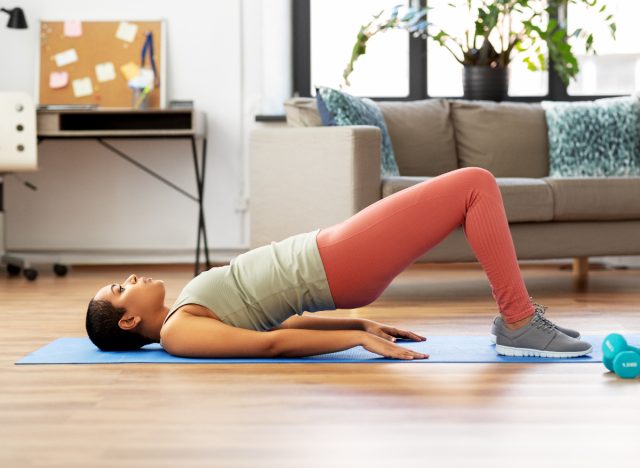
This test measures how long you can hold a clean bridge position without losing alignment. Start your timer once your hips reach full extension.
- Under 30 seconds: Needs Improvement
This range suggests limited endurance in the glutes and core. Fatigue may appear quickly during prolonged walking or standing.
- 30 to 60 seconds: Average
Your hips and core can handle everyday movement demands, though fatigue may show up during longer efforts.
- 60 to 90 seconds: Above Average
This score reflects strong glute endurance and solid pelvic stability.
- 90+ seconds: Top-Tier
This level demonstrates exceptional hip and core endurance. Your glutes maintain force output while your pelvis and spine stay controlled.
RELATED: 5 Dumbbell Exercises That Build Shoulder Strength Faster Than Machines After 60
The Best Tips for Building Stronger Hips and Glutes After 55
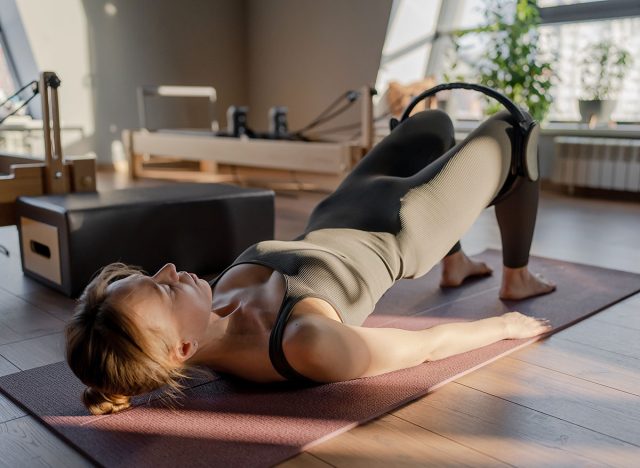
Stronger hips and glutes develop through consistent training that challenges both strength and endurance. These strategies help build a bridge hold that lasts longer while supporting overall movement quality.
- Practice bridges regularly: Perform two to three sets several times per week to build endurance in the glutes and core.
- Add single-leg variations: Single-leg bridges increase hip demand and improve pelvic control.
- Train other hip extension movements: Exercises like step-ups, kettlebell deadlifts, and hip thrusts strengthen the same muscle groups.
- Strengthen your core stabilizers: Planks, dead bugs, and carries improve trunk stability, which supports strong bridge holds.
- Focus on quality tension: Squeezing the glutes and maintaining alignment matter more than simply holding the position longer.
Strong hips and glutes influence nearly every movement you perform throughout the day. If you can hold a bridge for an extended period with clean form, you’re showing that the muscles supporting your spine and pelvis remain powerful, coordinated, and ready for whatever movement the day brings.
References
- Lehecka, B J et al. “BUILDING A BETTER GLUTEAL BRIDGE: ELECTROMYOGRAPHIC ANALYSIS OF HIP MUSCLE ACTIVITY DURING MODIFIED SINGLE-LEG BRIDGES.” International journal of sports physical therapy vol. 12,4 (2017): 543-549.
- Inacio, Mario et al. “Gluteal muscle composition differentiates fallers from non-fallers in community dwelling older adults.” BMC geriatrics vol. 14 37. 25 Mar. 2014, doi:10.1186/1471-2318-14-37
The post If You Can Hold a Bridge This Long After 55, Your Core Strength Is Top-Tier appeared first on Eat This Not That.
]]>The post The 8-Minute Daily Routine That Builds More Core Strength Than Planks After 65 appeared first on Eat This Not That.
]]>The best thing you can do for yourself to stay healthy and able to live life to its fullest, is to exercise regularly. Did you know that you can boost your core strength by dedicating just eight minutes to a daily fitness routine? Sure, planks have their place in a successful core workout. Cleveland Clinic says the plank is an effective bodyweight exercise that’s convenient, protects your back, boosts posture, improves mental wellness, and prevents workout-related injuries. However, we spoke with Steve Stonehouse, Vice President of Programming and Education at Body Fit Training (BFT), who breaks down a speedy workout that can build more core strength than planks after 65.
“To build a strong, ‘functional’ core, we need to move beyond just static holding. A truly strong core for a senior involves stability, rotation and even resistance to gravity while upright,” Stonehouse explains. “Farmer’s Carries, [for instance,] require the individual to ‘build tension’ within the deep core musculature which ultimately produces a ‘brace’ of sorts and protects the spine.”
Below, Stonehouse breaks down an eight-minute routine that builds more core strength than planks after 65. Perform the circuit twice.
Farmer’s Carry
- Hold a dumbbell in each hand at your sides.
- Start walking forward, keeping your torso still and maintaining a tall posture.
- Perform the exercise for 45 seconds, then rest for 15 seconds.
RELATED: 5 Core Moves That Burn Belly Fat Faster Than Crunches
Wall Pushups
- Begin standing tall, arms-length away from a wall.
- Place your hands shoulder-width apart on the surface.
- Engage your core and bend your elbows to lower your chest toward the wall.
- Press back up to the starting position, keeping the movement slow and controlled.
- Perform the exercise for 45 seconds, then rest for 15 seconds.
RELATED: 4 Daily Standing Drills That Flatten Belly Overhang Better Than Ab Workouts After 45
Bird Dog
- Start on all fours on a workout mat.
- Extend your left arm and right leg.
- Hold for 3 seconds before returning to the start position.
- Switch sides and continue to alternate.
- Perform the exercise for 45 seconds, then rest for 15 seconds.
RELATED: 5 Daily Walking Drills That Flatten Belly Overhang Better Than Ab Workouts After 45
Seated Dead Bugs
- Begin sitting tall on a sturdy chair or workout bench with your feet flat on the ground and knees bent to 90 degrees.
- Lean back just a bit while keeping your core engaged.
- Lift one knee up toward your chest while lifting the opposite arm overhead.
- Return to the start position and repeat on the opposite side.
- Continue to alternate, performing the exercise for 45 seconds, then resting for 15 seconds.
The post The 8-Minute Daily Routine That Builds More Core Strength Than Planks After 65 appeared first on Eat This Not That.
]]>The post 5 Chair Exercises That Build Core Strength Faster Than Planks After 60 appeared first on Eat This Not That.
]]>One thing I’ve learned coaching clients over the years is that exercises work best when they meet people where they’re at. Seated movements provide stability and support, allowing you to focus on engaging the muscles in your midsection rather than worrying about balance or getting up and down from the floor. That setup helps many people build foundational core strength while also gaining something just as important: confidence in their movements.
The five exercises below turn a simple chair into a surprisingly effective core-training station. Each movement challenges the abdominals, hips, and stabilizing muscles in a slightly different way. Perform them consistently, and you’ll build core strength that carries over into everyday movement.
Seated Knee Tucks
Seated knee tucks are a fantastic way to wake up the core while keeping the movement simple and controlled. As you draw your knees toward your chest, the abdominal muscles contract to stabilize the torso and guide the motion. Many people are surprised by how quickly they feel this exercise working on the lower core. The movement also trains coordination between the hips and abdominals, which plays a big role in everyday movement. With regular practice, knee tucks help strengthen the muscles that support the spine and stabilize the pelvis.
Muscles Trained: Rectus abdominis, hip flexors, and core stabilizers.
How to Do It:
- Sit toward the front edge of a chair with your hands holding the sides.
- Lean your torso back slightly while keeping your chest tall.
- Extend your legs forward.
- Pull your knees toward your chest.
- Extend your legs again with control.
Recommended Sets and Reps: Perform 3 sets of 12 to 15 reps. Rest for 30 seconds between each set.
Best Variations: Alternating knee tucks, slow tempo knee tucks, single-leg knee tuck.
Form Tip: Keep your chest lifted and avoid rounding your back.
RELATED: The 5-Minute Standing Routine That Restores Posture After 60, According to a Trainer
Seated Russian Twists
Russian twists strengthen the obliques, which help stabilize the torso during rotation. Many daily movements involve turning, reaching, or shifting direction, so these muscles work constantly behind the scenes. The twisting motion keeps the core engaged while the upper body rotates from side to side. This not only strengthens the waistline muscles but also improves coordination between the upper and lower body. Over time, stronger obliques support better posture and a more stable midsection.
Muscles Trained: Obliques, rectus abdominis, and core stabilizers.
How to Do It:
- Sit tall on the chair with your feet planted on the floor.
- Lean your torso back slightly while bracing your core.
- Hold your hands together in front of your chest.
- Rotate your torso to one side.
- Rotate to the opposite side and continue alternating.
Recommended Sets and Reps: Perform 3 sets of 16 to 20 alternating reps. Rest for 30 seconds between each set.
Best Variations: Weighted Russian twists, slow tempo twists, pause twists.
Form Tip: Rotate through your torso rather than swinging your arms.
Seated Leg Lifts
Seated leg lifts challenge the lower abdominal muscles and the hip flexors simultaneously. Lifting the legs requires the core to stabilize the torso while the hips move. This simple action strengthens the muscles that help control pelvic positioning and lower-body movement. Many clients notice that this exercise quickly wakes up the lower core. Practicing it regularly helps build strength that carries over into walking, climbing stairs, and other daily tasks.
Muscles Trained: Lower abdominals, hip flexors, and core stabilizers.
How to Do It:
- Sit tall on the chair with your hands gripping the sides.
- Brace your core and keep your chest lifted.
- Extend both legs forward.
- Lift your feet several inches off the floor.
- Lower your feet slowly back down.
Recommended Sets and Reps: Perform 3 sets of 10 to 12 reps. Rest for 30 seconds between each set.
Best Variations: Alternating leg lifts, slow tempo leg lifts, and single-leg lifts.
Form Tip: Move slowly and keep your core engaged throughout the lift.
RELATED: 4 Standing Exercises That Restore Thigh Strength Faster Than Squats After 60
Seated Marches
Seated marches train the core to stabilize while the legs move independently. Each time one knee lifts, the abdominal muscles work to keep the torso steady. This teaches the core how to maintain control during movement, which is essential for balance and coordination. The alternating pattern also promotes better hip mobility and rhythm. Over time, the movement strengthens the core while improving lower-body coordination.
Muscles Trained: Hip flexors, lower abdominals, and core stabilizers.
How to Do It:
- Sit tall with your feet flat on the floor.
- Brace your core and keep your chest upright.
- Lift one knee toward your chest.
- Lower the leg and lift the opposite knee.
- Continue alternating in a steady rhythm.
Recommended Sets and Reps: Perform 3 sets of 20 alternating reps. Rest for 30 seconds between each set.
Best Variations: Slow-tempo marches, pause marches, alternating-hold marches.
Form Tip: Keep your torso tall and avoid leaning backward as you lift each knee.
Seated Pallof Hold
The pallof hold trains the core to resist rotation, which is one of the most important functions of the abdominal muscles. Instead of bending or crunching the torso, the core works to keep the body steady while the arms extend away from the chest. That small shift in leverage keeps the deep stabilizing muscles around the spine engaged. Many people are surprised by how quickly this movement lights up the midsection. Over time, exercises like this build the kind of core stability that supports posture, balance, and everyday movement.
Muscles Trained: Transverse abdominis, obliques, shoulders, and core stabilizers.
How to Do It:
- Sit tall on a chair beside a resistance band anchor point.
- Hold the band with both hands at chest height.
- Brace your core and extend your arms straight out in front of you.
- Keep your torso still while the band pulls to the side.
- Hold the position before bringing your hands back toward your chest.
Recommended Sets and Reps: Perform 3 sets of 20 to 30 second holds per side. Rest for 30 seconds between each set.
Best Variations: Standing Pallof hold, kneeling Pallof hold, Pallof press.
Form Tip: Keep your shoulders level and avoid letting the band rotate your torso.
RELATED: 4 Standing Exercises That Restore Thigh Strength Faster Than Squats After 60
Best Daily Tips for Building Core Strength After 60
Strong core muscles support posture, balance, and everyday movement. Building that strength does not require complicated workouts or uncomfortable positions on the floor. Simple, consistent routines often produce the most noticeable results.
- Train the core regularly: Short daily sessions often build strength faster than occasional long workouts.
- Focus on controlled movement: Smooth, deliberate repetitions help activate the deeper core muscles.
- Strengthen the hips and abdomen together: These muscle groups work as a team to stabilize the body.
- Maintain upright posture during exercises: Sitting tall encourages better core engagement.
- Stay consistent: Regular practice helps the core grow stronger and more supportive over time.
Stick with these chair exercises, and you’ll build a stronger, more stable core that supports the rest of your movement.
References
- Rodríguez-Perea, Ángela et al. “Core training and performance: a systematic review with meta-analysis.” Biology of sport vol. 40,4 (2023): 975-992. doi:10.5114/biolsport.2023.123319
- Zhong, Yuanji et al. “Effects of core training on balance performance in older adults: a systematic review and meta-analysis.” Frontiers in public health vol. 13 1661460. 9 Oct. 2025, doi:10.3389/fpubh.2025.1661460
The post 5 Chair Exercises That Build Core Strength Faster Than Planks After 60 appeared first on Eat This Not That.
]]>The post If You Can Hold a Side Plank This Long After 60, Your Core Stability Is Top-Tier appeared first on Eat This Not That.
]]>We spoke with Karen Ann Canham, CEO and founder of Karen Ann Wellness, a board-certified wellness coach and nervous system specialist with nearly two decades of experience in wellness and corporate leadership, to learn how long you should be able to hold a side plank after 60 for your core stability to rank as top-tier.
Why Core Stability Matters

A strong, stable core is one of the most critical foundations of safe movement as you grow older.
“A strong core helps: maintain upright posture, reducing strain on the spine; stabilize the pelvis during walking, which improves gait efficiency; improve balance reactions when the body is pushed or shifts unexpectedly; [and] reduce fall risk, especially during movements like stepping, turning, or reaching,” Canham notes. “Research consistently shows that older adults with stronger core and hip stabilizers have better balance control and greater confidence in daily movement.”
RELATED: If You Can Hold a Plank This Long After 50, Your Core Is Stronger Than Most
If You Can Hold a Side Plank This Long After 60, Your Core Stability Is Top-Tier
For those 60+, core endurance benchmarks shift naturally due to joint tolerance, muscle mass, and recovery capacity.
“A solid baseline for most healthy adults over 60 is holding a side plank for 15 to 25 seconds per side with good form,” says Canham. “An above-average hold would be 30 to 45 seconds per side, while 60 seconds or more with stable alignment would be considered exceptional for this age group.”
What’s most important is maintaining solid alignment. This means keeping your shoulders stacked, spine neutral, and hips lifted rather than aiming for a longer time while using poor form.
RELATED: If You Can Do This Many Squats After 50, You Are in Great Shape
Muscles Side Planks Activate

Side planks engage several important stabilizing muscles that work in unison to support the pelvis and spine. The main muscles fired up in side planks include the obliques, glute medius, glute maximus, transverse abdominis (also known as the deep “corset” muscle), and quadratus lumborum.
“Together, these muscles create a strong lateral support system for the spine, allowing the body to resist side-to-side movement,” Canham tells us.
RELATED: Over 50? If You Can Do This Many Knee Pushups, Your Upper Body Is Stronger Than Most
Side Planks Train Anti-Lateral Flexion
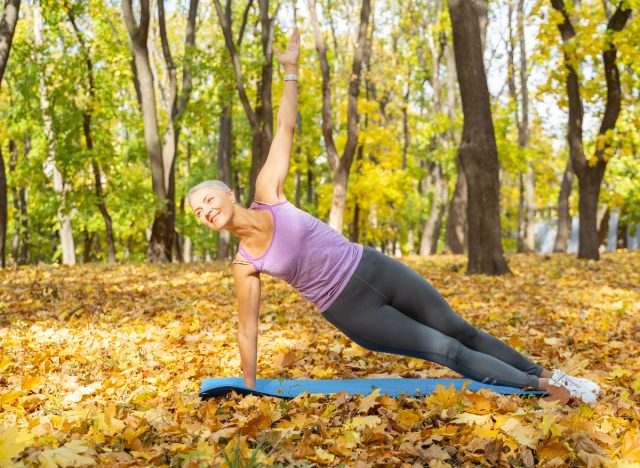
While classic front planks mainly challenge anti-extension strength—which helps your lower back resist arching—side planks train anti-lateral flexion. This means your body must resist the urge to bend sideways.
“This is particularly important because many balance challenges in everyday life occur side-to-side, such as stepping off a curb, carrying a bag, or recovering from a stumble,” Canham explains. “Side planks also activate the obliques and hip stabilizers more directly than front planks, making them especially valuable for improving lateral stability and fall resistance in older adults.”
The post If You Can Hold a Side Plank This Long After 60, Your Core Stability Is Top-Tier appeared first on Eat This Not That.
]]>The post 5 Bed Exercises That Restore Core Strength Faster Than Planks After 60 appeared first on Eat This Not That.
]]>Training the core from a lying position removes joint strain while allowing deeper muscle activation. The abdominal wall, deep stabilizers, and hip flexors all respond well to slow, deliberate contractions performed with full control. Many of my clients see faster improvements when they focus on tension, breathing, and movement quality rather than simply holding a static plank position.
Another benefit of bed-based exercises involves consistency. If a workout feels easy to start and comfortable to perform, people stick with it longer. A soft but stable surface like a firm mattress allows controlled core work without the discomfort that often discourages daily training. When clients practice these movements every morning or evening, core strength steadily returns.
The five exercises below focus on slow tension, controlled breathing, and continuous abdominal engagement. Perform them deliberately and concentrate on squeezing the midsection during every repetition. Over time, these movements build deep core stability that translates directly to stronger posture, better balance, and improved daily movement.
Lying Knee Tucks
Knee tucks activate the entire abdominal wall while keeping the lower back supported. I frequently start clients over 60 with this movement because it teaches the core to contract properly without strain. The movement may look simple, but when performed slowly with full abdominal engagement, the muscles fatigue quickly.
Lie comfortably on your back with legs extended. Draw both knees toward your chest while tightening the abdominal muscles, then slowly extend the legs again without letting your lower back lift off the bed. Maintain steady breathing and move deliberately throughout each repetition.
How to Do It
- Lie flat with legs extended
- Pull both knees toward chest
- Tighten abdominal muscles
- Extend legs slowly
- Repeat with controlled movement.
RELATED: 5 Morning Exercises That Firm Belly Overhang Faster Than Pilates After 60
Heel Slides
Heel slides train the deep stabilizing muscles of the core while keeping the movement extremely joint-friendly. I often use this drill with clients recovering from long periods of inactivity because it strengthens the midsection without stressing the spine.
Lie on your back with knees bent and feet flat on the bed. Slowly slide one heel away from your body until the leg nearly straightens. Pause briefly while keeping your abs tight, then slide the heel back toward your hips. Alternate legs while maintaining steady abdominal tension.
How to Do It
- Lie on back with knees bent
- Slide one heel forward slowly
- Keep core muscles tight
- Pause briefly at extension
- Return heel and switch legs.
Lying Leg Lifts
Leg lifts strengthen the lower portion of the abdominal muscles, an area that often weakens with age. Many of my clients notice improved core endurance within a few weeks of practicing controlled leg lifts regularly.
Lie flat on your back with legs extended and hands resting at your sides. Lift both legs several inches off the bed while tightening the abdominal muscles. Hold briefly before lowering slowly, keeping the lower back pressed gently into the mattress.
How to Do It
- Lie flat with legs extended
- Lift both legs slightly upward
- Tighten abdominal muscles
- Hold briefly
- Lower legs slowly.
RELATED: If You Can Do This Many Squats After 55, Your Leg Strength Is Top 10%
Alternating Bed March
The alternating march strengthens both the core and hip stabilizers while reinforcing proper abdominal engagement. I like this movement because it teaches controlled leg motion while the midsection stays braced.
Lie on your back with knees bent and feet flat. Lift one knee toward your chest while keeping your abdominal muscles tight. Lower the foot slowly and repeat with the opposite leg. Move rhythmically while maintaining steady breathing.
How to Do It
- Lie with knees bent
- Lift one knee toward chest
- Keep abs braced
- Lower slowly
- Alternate legs continuously.
RELATED: 5 Exercises Men Over 50 Should Do Each Morning to Restore Fading Muscle
Lying Toe Reaches
Toe reaches strengthen the upper abdominal muscles while encouraging spinal stability. This movement often surprises clients because it produces a strong core contraction without requiring a full sit-up or crunch.
Lie flat on your back and lift both legs toward the ceiling. Reach both hands upward toward your toes while tightening the abdominal muscles. Lower your shoulders slowly back to the bed before repeating the movement.
How to Do It
- Lie on back with legs raised
- Reach hands toward toes
- Tighten abdominal muscles
- Lower shoulders slowly
- Repeat with control.
The post 5 Bed Exercises That Restore Core Strength Faster Than Planks After 60 appeared first on Eat This Not That.
]]>The post 5 Beginner Exercises That Build Core Strength Faster Than Planks After 55 appeared first on Eat This Not That.
]]>Here’s the reality: we lose muscle mass faster as we age due to sarcopenia. That affects balance, bone density, metabolic health, and longevity. And for women, hormonal changes around menopause add another layer of challenge. On top of that, many of my clients are navigating arthritis pain, slower reaction times, and a higher fall risk than they had in their younger years.
A plank is often the go-to core exercise—but it’s not always the right starting point. Holding a plank properly requires adequate upper body strength, a solid foundation of core stability, and the ability to integrate all parts of the body in a single isometric hold. For someone new to exercise, that’s a big ask.
That’s why I put together this three-move core circuit. These exercises build the exact strength and coordination you need to work toward a plank—and they’ll make everything else you do feel easier along the way.
Why Core Strength Matters More After 55

Core strength is key to maintaining balance, good posture, and proper form in all your exercise programming. After 55, it becomes even more non-negotiable.
In my line of work, I see plenty of people over 55 who can hold a plank with great form. But these people are exceptional in their fitness and dedication. For most older adults who are newer to exercise, the gap isn’t effort—it’s foundation. These three exercises are designed to build that foundation.
RELATED: The Only 4 Gym Machines You Need After 55 to Rebuild Lost Muscle
High Knees with Overhead Dumbbell Hold
I love this move because it trains anti-extension (not leaning backward), core stabilization under asymmetrical loading, and shoulder strength and stability all at once. It’s also a great option for someone who isn’t comfortable getting up and down off the floor.
Muscles Trained: Shoulders, core stabilizers, hip flexors, obliques
How to Do It:
- Grab a light to medium dumbbell in your right hand
- Stand tall and steady
- Slowly raise the weight overhead if you’re able
- Extend your opposite arm out to the side for added balance
- With control, lift one knee at a time, marching in place while stabilizing your core
- Complete 20 reps (10 per side) before carefully switching the weight to your other hand
Recommended Sets and Reps: 20 reps per arm (10 knee lifts per side), 3 rounds as part of the full circuit
Form Tip: Don’t lean back as you raise the weight—keep your ribs down and core tight to resist that backward pull.
Bird Dogs
Bird dogs train cross-body coordination and spinal stability. If you can master this move, you’ll be well on your way to executing a perfect plank.
Muscles Trained: Glutes, lower back, transverse abdominis, shoulders
How to Do It:
- Start in a tabletop position on hands and knees
- Slowly extend your right leg behind you horizontally
- At the same time, extend your left arm straight in front of you
- Hold for up to 30 seconds
- Switch sides and repeat
Recommended Sets and Reps: Up to 30 seconds per side, 3 rounds as part of the full circuit
Form Tip: Don’t let your hips rotate or your lower back arch—keep your spine neutral and move slowly and deliberately.
RELATED: If You Can Do This Many Pushups After 50, Your Upper-Body Strength Is Top-Tier
Hollow Hold
This one is a particularly challenging core exercise, and I mean that as a compliment. It involves the isometric tightening of the deep core muscles in exactly the way a plank does. The whole front chain of the body has to engage. One of the key elements to a proper plank is not allowing the lower back to sway—and the hollow hold trains the lower abs to engage in exactly that way. Personally, I still can’t do this move without my abs shaking.
Muscles Trained: Deep core (transverse abdominis), lower abs, hip flexors, shoulders
How to Do It:
- Lie on your back on your mat
- Press your lower back firmly into the mat
- Lift your head and feet just a couple of inches off the floor
- Reach your fingertips toward your feet
- Hold for up to 30 seconds
Recommended Sets and Reps: Up to 30 seconds, 3 rounds as part of the full circuit
Form Tip: Don’t let your lower back lift off the mat—that’s the whole point of the move. Keep pressing it down the entire time.
How to Add This Circuit to Your Week
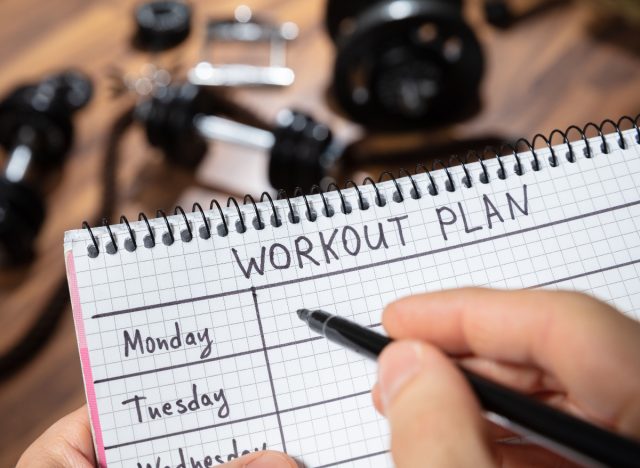
If you’re just starting your fitness journey, I’d recommend placing this core circuit at the end of your workout routine one to two times per week. Do all three moves back to back, then repeat the circuit three times through.
Always listen to your body—and your doctor gets the final word on what exercise program is right for you.
RELATED: 5 Bed Exercises That Restore Leg Strength Faster Than Squats After 60
What to Expect in 4–6 Weeks
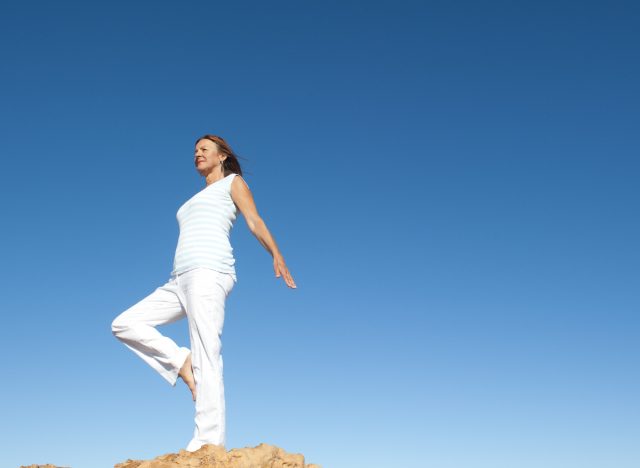
Realistic is the keyword here. I always have to remind my clients that they can’t sit-up and plank their way to a set of six-pack abs—nutrition and lifestyle are major factors when it comes to aesthetic results.
That said, here’s what you can realistically expect after four to six weeks of including these moves in your routine:
- Stronger, more stable shoulders and chest muscles
- Stronger hip flexors
- Better balance
- Improved core strength and stability that carries over into other exercises and daily activities
- A slimmer waistline, if paired with proper nutrition
- Real progress toward holding a plank, if that’s one of your goals
The payoff is worth it. These moves quietly do a lot of work—and so will you.
The post 5 Beginner Exercises That Build Core Strength Faster Than Planks After 55 appeared first on Eat This Not That.
]]>The post If You Can Master These 4 Bed Exercises at 60, Your Core Is Stronger Than Most 50-Year-Olds appeared first on Eat This Not That.
]]>Bed-based core training offers a simple and highly effective starting point, especially if floor work feels uncomfortable or intimidating. The supportive surface helps reduce pressure on the hips and spine while still allowing the deep stabilizers to switch on and do their job. Many of my clients notice they can connect more clearly to their core when they begin their day with bed exercises because the setup feels approachable and controlled. That combination makes it easier to focus on breathing, positioning, and clean movement from the very first session.
I program these movements often because they help people build confidence quickly while laying down a strong foundation for long-term strength. As the core gets stronger, daily movement starts to feel more automatic and less fatiguing. Master the four exercises below with steady control, and you will put your core strength in an impressive place for your age.
RELATED: 4 Seated Exercises That Flatten Lower Belly Pooch Faster Than Crunches After 50
Dead Bug
Link: The dead bug teaches your core how to resist movement while your arms and legs stay active. That skill transfers directly to walking, lifting, and balance. Many people think of core training as bending and twisting, yet the ability to stay stable often matters more. I program dead bugs frequently because they help clients quickly “find” their deep core muscles. When performed with intent, this move builds impressive control without stressing the spine.
Muscles Trained: Rectus abdominis, transverse abdominis, hip flexors, and obliques
How to Do It:
- Lie on your back on the bed with your arms extended toward the ceiling and your knees bent at 90 degrees.
- Brace your core and press your lower back gently into the bed.
- Extend your right arm overhead while lowering your left leg toward the bed.
- Stop just before your heel touches the surface.
- Return to the starting position with control.
- Alternate sides and continue the pattern.
Recommended Sets and Reps: Perform 3 sets of 8 to 12 reps per side. Rest for 45 to 60 seconds between each set.
Best Variations: Bent knee dead bug, slow tempo dead bug, band resisted dead bug
Form Tip: Keep your lower back gently pressed into the bed throughout each rep.
Reverse Crunch
The reverse crunch strengthens the lower portion of the abdominal wall and teaches your hips and core to work together. This pattern helps with movements that require lifting and controlling the legs. Many adults feel this exercise lights up the lower core in a way traditional crunches do not. I like it because it builds strength while staying friendly on the neck and upper back. When done slowly, it delivers serious core engagement.
Muscles Trained: Lower abdominals, hip flexors, obliques, and deep core stabilizers
How to Do It:
- Lie on your back with your knees bent and your feet resting lightly on the bed.
- Place your arms by your sides for support.
- Brace your core and draw your knees toward your chest.
- Lift your hips slightly off the bed using your abdominals.
- Lower your hips and feet back down under control.
- Reset and repeat smoothly.
Recommended Sets and Reps: Perform 3 sets of 10 to 15 reps. Rest for 45 to 60 seconds between each set.
Best Variations: Slow tempo reverse crunch, pause reverse crunch, alternating reverse crunch
Form Tip: Think about curling your hips upward rather than swinging your legs.
RELATED: The 6-Minute Bed Routine That Restores Thigh Strength Faster Than Squats After 55
Russian Twist
The Russian twist builds rotational strength that supports turning, reaching, and maintaining trunk control during walking. Many adults lose rotational capacity as they age, which can affect balance and fluid movement. I often include this exercise to restore controlled rotation without requiring standing balance. When performed with a steady tempo, it strengthens the obliques while reinforcing core endurance. It also adds variety to core training routines.
Muscles Trained: Obliques, rectus abdominis, hip flexors, and deep core stabilizers
How to Do It:
- Sit on the bed with your knees bent and your heels resting lightly on the surface.
- Lean your torso back slightly while keeping your chest tall.
- Brace your core and rotate your shoulders to the right.
- Return through the center with control.
- Rotate your shoulders to the left.
- Continue alternating sides smoothly.
Recommended Sets and Reps: Perform 3 sets of 12 to 20 total rotations. Rest for 45 to 60 seconds between each set.
Best Variations: Feet elevated twist, slow tempo twist, light weight twist
Form Tip: Rotate through your torso, not just your arms.
Supine Knee Tucks
Supine knee tucks combine lower core strength with controlled hip movement. This exercise challenges your ability to maintain tension while the legs move in and out. I like programming knee tucks because they build endurance that carries over well to walking and stair climbing. Many clients notice improved awareness of the lower core within a few sessions. Performed consistently, this move strengthens the entire front side of the core.
Muscles Trained: Lower abdominals, hip flexors, rectus abdominis, and transverse abdominis
How to Do It:
- Lie on your back with your legs extended and your arms by your sides.
- Brace your core and lift your feet slightly off the bed.
- Draw your knees toward your chest under control.
- Pause briefly while maintaining tension.
- Extend your legs back out without letting your lower back arch.
- Repeat with smooth, steady movement.
Recommended Sets and Reps: Perform 3 sets of 10 to 15 reps. Rest for 45 to 60 seconds between each set.
Best Variations: Alternating knee tucks, slow tempo knee tucks, bent knee tucks
Form Tip: Keep your core braced to keep your lower back stable against the bed.
RELATED: The 7-Minute Chair Routine That Restores Muscle Tone Faster Than Weight Training After 60
The Best Tips for Building Core Strength After 60

Building a strong core after 60 comes down to consistency, control, and smart exercise selection. The body still adapts extremely well when you give it the right stimulus and enough recovery. I’ve watched many clients regain noticeable stability and confidence in just a few months once they commit to focused core work. The key is to train the midsection regularly without rushing through reps. Quality always drives better results than speed. Use the tips below to keep your progress moving forward.
- Train your core three to four days per week: Frequent exposure builds endurance and coordination faster.
- Prioritize slow, controlled reps: Moving with intention helps the deep stabilizers engage more fully.
- Focus on breathing while you brace: Steady breathing supports better tension and longer sets.
- Progress gradually over time: Add a few reps or extra seconds rather than making large jumps.
- Support your core with full-body strength work: Exercises like carries and step-ups reinforce trunk stability.
- Stay consistent week after week: Small improvements compound quickly when training stays regular.
Stick with these habits, and your core strength can rival people many years younger.
References
- Maccarone, Maria Chiara et al. “Effects of the Full-Body in-Bed Gym program on quality of life, pain and risk of sarcopenia in elderly sedentary individuals: preliminary positive results of a Padua prospective observational study.” European journal of translational myology vol. 33,3 11780. 26 Sep. 2023, doi:10.4081/ejtm.2023.11780
- Burtscher, Johannes et al. “How much resistance exercise is beneficial for healthy aging and longevity?.” Journal of sport and health science vol. 12,3 (2023): 284-286. doi:10.1016/j.jshs.2022.11.004
The post If You Can Master These 4 Bed Exercises at 60, Your Core Is Stronger Than Most 50-Year-Olds appeared first on Eat This Not That.
]]>The post The 7-Minute Bed Routine That Restores Core Strength Faster Than Planks After 55 appeared first on Eat This Not That.
]]>One of the most effective ways to spark that progress is to use supported positions that let your core do the work without extra strain. Bed-based training creates a stable environment where you can focus on control, breathing, and clean movement patterns. In my coaching history, when clients start to feel their midsection switch on early in the process, their consistency usually climbs right along with it.
This 7-minute bed routine brings together four highly effective movements that target your entire midsection in a joint-friendly position. You will build strength, improve control, and reinforce the deep core muscles that support your spine. Here is exactly how to perform the routine for the best results.
RELATED: The 6-Minute Bed Routine That Restores Thigh Strength Faster Than Squats After 55
The 7 Minute Bed Routine

What you need: A sturdy bed and seven uninterrupted minutes. This routine uses four controlled core exercises performed in short intervals to challenge your entire midsection.
The Routine:
- Dead Bugs: 30 seconds
- Reverse Crunches: 30 seconds
- Russian Twists: 30 seconds
- Supine Knee Tucks: 30 seconds
Complete the circuit for 3 rounds.
Directions:
Set a timer for 30-second intervals. Perform each exercise back-to-back in the order listed. Move with control and focus on keeping your core braced throughout each interval. Complete the full circuit three times. Read on for the detailed instructions.
Dead Bugs
Dead bugs train your deep core muscles to stabilize while your arms and legs move. This pattern directly supports spine stability and teaches your midsection to resist unwanted motion. I program this exercise often because many adults quickly feel their lower abs switch on when it is done correctly. Over time, stronger deep core control carries over into better posture and safer movement.
How to do it:
- Lie on your back on the bed with arms extended toward the ceiling.
- Lift your knees so your hips and knees form ninety-degree angles.
- Brace your core and press your lower back gently into the bed.
- Lower one arm and the opposite leg slowly toward the bed.
- Return to the starting position with control.
- Alternate sides for the full interval.
Best Variations: Bent knee dead bugs, slower tempo dead bugs, heel tap dead bugs.
RELATED: The 7-Minute Chair Routine That Restores Muscle Tone Faster Than Weight Training After 60
Reverse Crunches
Reverse crunches place strong emphasis on the lower portion of the abdominal wall, an area that often weakens with age. This movement trains your pelvis to tilt under control, strengthening the muscles that support the front of your core. I like using reverse crunches because they create a clear contraction without requiring neck strain or momentum. With consistent practice, this exercise helps tighten and strengthen the lower midsection.
How to do it:
- Lie on your back with knees bent and feet lifted.
- Place your arms at your sides for support.
- Brace your core and gently tilt your pelvis upward.
- Lift your hips slightly off the bed using your abs.
- Lower back down slowly with control.
- Repeat for the full interval.
Best Variations: Bent knee reverse crunch, slow tempo crunch, pause at top crunch.
Russian Twists
Russian twists strengthen the obliques, which help your body rotate and stabilize during daily movement. Strong obliques support better trunk control and contribute to a more connected feeling through your midsection. I often include this exercise once clients build basic front core strength because it rounds out total core development. Over time, improved rotational strength supports better balance and coordination.
How to do it:
- Sit on the bed with knees bent and feet lightly on the surface.
- Lean your torso back slightly while keeping your chest lifted.
- Brace your core and clasp your hands together.
- Rotate your torso to one side with control.
- Rotate to the opposite side.
- Continue alternating for the full interval.
Best Variations: Feet elevated twists, slower tempo twists, weighted twists.
RELATED: If You Can Hold These 4 Positions After 55, Your Hip Mobility Is Elite
Supine Knee Tucks
Supine knee tucks challenge your entire abdominal wall while reinforcing coordinated hip and core movement. This exercise builds strength through a full range of motion and teaches your midsection to stay engaged as your legs move. I use knee tucks frequently because they deliver a strong stimulus in a short time window. Consistent practice helps improve core endurance and overall control.
How to do it:
- Lie on your back with legs extended.
- Place your hands lightly at your sides.
- Brace your core and draw both knees toward your chest.
- Pause briefly at the top position.
- Extend your legs back out with control.
- Repeat for the full interval.
Best Variations: Single-leg knee tucks, slower tempo tucks, extended hold tucks.
RELATED: The 8-Minute Morning Routine That Tightens Arm Flab Faster Than Weight Training After 55
Best Daily Habits to Strengthen Your Core After 55

Core strength improves fastest when short workouts pair with supportive daily habits. The muscles of the midsection respond well to frequent activation and consistent movement patterns. In my experience working with adults over 55, the biggest improvements usually come from simple habits repeated often rather than occasional intense sessions. Stay patient and focus on quality effort. Your core will respond when the work stays consistent. Use the tips below to reinforce your progress.
- Train your core most days of the week: Frequent activation builds endurance and control.
- Move with intention during daily tasks: Bracing lightly during lifts and transitions reinforces core strength.
- Prioritize protein intake: Adequate protein supports muscle maintenance throughout the midsection.
- Focus on posture throughout the day: Stacked ribs and hips keep your core lightly engaged.
- Progress your intervals gradually: Longer work periods help maintain steady improvement.
- Stay consistent with short routines: Small daily efforts build meaningful long-term results.
Stick with this seven-minute routine and these habits, and many adults over 55 begin to feel stronger through their midsection with better posture and more confident movement.
References
- Zhong, Yuanji et al. “Effects of core training on balance performance in older adults: a systematic review and meta-analysis.” Frontiers in public health vol. 13 1661460. 9 Oct. 2025, doi:10.3389/fpubh.2025.1661460
- Maccarone, Maria Chiara et al. “Effects of the Full-Body in-Bed Gym program on quality of life, pain and risk of sarcopenia in elderly sedentary individuals: preliminary positive results of a Padua prospective observational study.” European journal of translational myology vol. 33,3 11780. 26 Sep. 2023, doi:10.4081/ejtm.2023.11780
The post The 7-Minute Bed Routine That Restores Core Strength Faster Than Planks After 55 appeared first on Eat This Not That.
]]>The post 5 Standing Exercises That Rebuild Core Strength Faster Than Gym Classes After 50 appeared first on Eat This Not That.
]]>Research shows that older adults benefit more from exercises that improve stability, balance, and activation of deep core muscles like the transverse abdominis. These muscles wrap around your torso like a corset and are essential for spinal protection and trunk stability. According to recent studies, boosting your core strength with standing exercises can improve balance, reduce fall risk, and decrease lower back pain in adults over 50 better than traditional abdominal exercises.
However, knowing which standing exercises are best for rebuilding core strength can be tricky. The good news is we’re here to help. We chatted with James Brady, personal trainer at OriGym, who shares his top five standing core exercises for those in their 50s, 60s, and beyond.
“Standing core work offers additional advantages,” Brady says. “It reduces pressure on the spine compared to repeated flexion movements and integrates the hips, glutes, and upper body, which are muscles that are essential for real-world function.”
Read on for the exercises and detailed instructions for each. Then, when you’re finished, check out these 5 Morning Exercises That Flatten Belly Overhang Better Than Gym Classes After 55.
Standing March
First up are standing marches. This move is an excellent way to rebuild deep core strength. By lifting one knee at a time while keeping the torso tall and the ribs stacked over the hips, your deep core stabilizing muscles switch on automatically.
How to do it:
- Stand tall with your feet hip-width apart.
- Stack your ribs directly over your hips.
- Engage your stomach as if you’re about to cough.
- Lift one knee slowly toward hip height.
- Avoid leaning backward or swaying side to side.
- Pause for one to two seconds at the top.
- Lower your foot back down with control.
- Perform two to three sets of 12 to 16 total marches (alternating legs), resting for 30 to 45 seconds between sets.
Bodyweight Squat With Overhead Reach
Squatting activates your glutes and quads, which are crucial for supporting your pelvis and lower back. Adding a controlled overhead reach to this classic move increases core activation by forcing your abs to stabilize as your arms move.
How to do it:
- Stand tall with your feet shoulder-width apart.
- Brace your core gently.
- Sit your hips back as if sitting into a chair and lower into a squat.
- Keep your chest upright and your knees tracking over your toes.
- As you stand up, reach both arms overhead slowly.
- Avoid arching your lower back during the reach.
- Lower your arms back down with control.
- Complete two to three sets of 10 to 15 reps. Rest for 45 to 60 seconds between sets.
RELATED: 5 Morning Exercises That Shrink Belly Pooch Faster Than Ab Workouts After 55
Standing Oblique Knee Drive
The standing oblique knee drive targets your muscles that shape and support the sides of your core. Bringing your knee up toward your opposite elbow while remaining upright trains rotation control rather than uncontrolled twisting. After 5, this control is essential since joint stability now matters more than speed.
How to do it:
- Stand tall with your feet hip-width apart.
- Place your hands lightly behind your head or in front of your chest.
- Flex your core gently.
- Lift your right knee toward your left elbow.
- Rotate your torso slightly without collapsing forward.
- Pause for one to two seconds when your elbow and knee meet.
- Return to the starting position with control.
- Aim for two to three sets of 10 to 12 reps per side, resting for 30 to 45 seconds between sets.
Wall Plank Hold
This variation of the classic plank involves pressing your forearms into a wall while stepping your feet back to engage the entire core, glutes, and upper back. Since your body remains upright during the movement, it’s easier to maintain alignment and keep tension in your abdominal wall.
How to do it:
- Stand facing a wall.
- Place your forearms against the wall at shoulder height.
- Step your feet back until your body forms a straight line.
- Brace your core and squeeze your glutes.
- Press your forearms into the wall.
- Keep your neck neutral and your shoulders stable.
- Hold while breathing steadily through your nose.
- Hold for 20 to 40 seconds for two to three sets. Rest for 30 to 45 seconds between holds.
RELATED: If You Can Do These 4 Morning Stretches Pain-Free After 60, Your Joint Health Is Exceptional
Standing Anti-Rotation Press
Anti-rotation training strengthens your deep core stabilizing muscles by teaching your body to resist twisting forces. This movement is fantastic for older adults to build core endurance and trunk control.
How to do it:
- Attach a resistance band at chest height to a sturdy anchor.
- Stand sideways to the anchor point.
- Hold the band with both hands at your chest.
- Step back slightly to create tension.
- Engage your core and keep your hips facing forward.
- Press the band straight out in front of you.
- Resist the pull of the band without rotating.
- Bring your hands back to your chest slowly.
- Perform two to three sets of 8 to 12 presses per side, resting for 30 to 45 seconds between sets.
The post 5 Standing Exercises That Rebuild Core Strength Faster Than Gym Classes After 50 appeared first on Eat This Not That.
]]>