The post 5 Chair Exercises That Restore Full-Body Balance Faster Than Yoga After 65 appeared first on Eat This Not That.
]]>Chair exercises create that environment. They provide support when needed while still forcing the body to stabilize, adjust, and coordinate movement. I’ve worked with many older clients who felt unsteady standing for long periods, yet quickly improved once they practiced controlled movements from a seated position. The chair removes fear while still allowing the nervous system and muscles to rebuild balance together.
Another key factor involves repetition. Balance improves when the body repeatedly practices controlled shifts in weight, posture, and coordination. These exercises do exactly that without overwhelming the joints or requiring complex sequences. When performed daily, they retrain how the body responds to movement and instability.
The following exercises focus on coordination, core engagement, and lower-body control. Move slowly, stay aware of your posture, and focus on smooth, deliberate motion. With consistency, these drills help rebuild the full-body balance needed for confident movement.
Seated March With Hold
This exercise trains coordination between the core and hips while reinforcing balance through controlled movement. I use this frequently because it mimics walking while keeping the body supported. Lifting one leg at a time challenges stability, especially when you add a brief hold at the top.
That hold forces the core to engage and the body to stay upright without shifting side to side. Over time, this builds the stability needed for walking and standing without feeling off balance.
How to Do It
- Sit tall with feet flat on the floor
- Lift one knee toward your chest
- Hold for 2–3 seconds
- Lower slowly
- Alternate legs continuously.
RELATED: If You Can Hold a Wall Sit This Long After 60, Your Leg Strength Is Top-Tier
Seated Reach and Return
This movement challenges balance by shifting your center of gravity forward and backward. I often include this exercise because it teaches the body how to control movement without losing stability.
Reaching forward forces the core and hips to engage while preventing you from tipping too far. Returning upright requires controlled strength. These small adjustments play a big role in real-world balance.
How to Do It
- Sit upright near the edge of a chair
- Extend both arms forward
- Reach slightly forward from the hips
- Return slowly to upright
- Repeat with control.
Seated Heel-to-Toe Taps
This exercise strengthens coordination in the lower legs and improves awareness of foot placement. I’ve seen major balance improvements when clients train the feet and ankles, since they act as the body’s foundation.
Alternating between heel and toe taps challenges control and rhythm. This helps the body respond more quickly to small shifts in balance during walking or standing.
How to Do It
- Sit tall with feet flat
- Lift toes while keeping heels down
- Then press toes down and lift heels
- Alternate smoothly
- Keep movements controlled.
RELATED: The 7-Minute Standing Routine That Restores Core Strength Faster Than Floor Exercises After 60
Seated Cross-Body Reaches
Cross-body movement improves coordination between the upper and lower body. I use this exercise often because it forces the core to stabilize while the arms move across the body.
Reaching across engages the obliques and teaches the body to maintain balance during rotational movement. This becomes especially useful for everyday tasks like turning or reaching.
How to Do It
- Sit tall with arms relaxed
- Reach one arm across your body
- Keep your torso stable
- Return slowly
- Alternate sides.
Seated Single-Leg Hold
This movement isolates balance on one side of the body while keeping the other supported. I rely on this exercise because it builds unilateral control, which is essential for walking and standing.
Holding one leg extended forces the core and hips to stabilize. Even though you’re seated, the body still works to maintain alignment and control.
How to Do It
- Sit tall with both feet on the floor
- Extend one leg forward
- Hold for several seconds
- Keep your core tight
- Switch legs and repeat.
The post 5 Chair Exercises That Restore Full-Body Balance Faster Than Yoga After 65 appeared first on Eat This Not That.
]]>The post The 6-Minute Bed Routine That Restores Full-Body Balance After 65 appeared first on Eat This Not That.
]]>Muscle mass and bone density decrease naturally as you age. By building strength, you’ll boost your balance and overall quality of life. We spoke with Doug Bertram, M.S., L.Ac., MTCM, Founder & CEO of orthopedic wellness franchise Structural Elements®, and are here with a six-minute bed routine that will restore your full-body balance after 65.
Why Balance Tends To Decline With Age
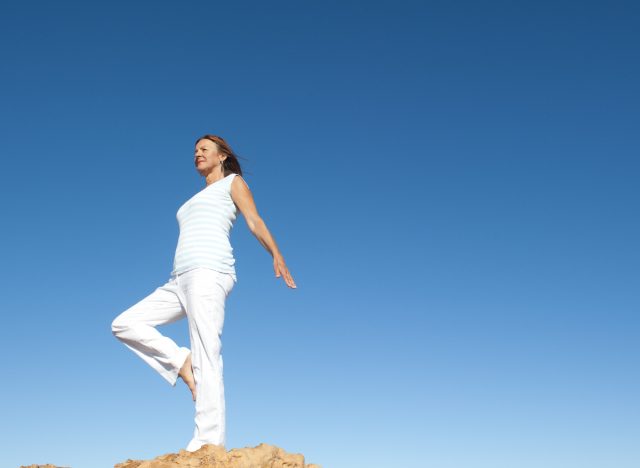
There’s a popular saying that goes, “Use it or lose it.” With age, it’s common to stop embracing new challenges and become a creature of habit.
“We golf nine holes every Wednesday at 11 am with Larry and have a cup of clam chowder afterward. Our routines become predictable, and the body adapts to doing the same things over and over. But it’s new challenges that keep us resilient,” explains Bertram. “One of the first planes of movement to go is often rotation. We walk, maybe even run, but stop moving laterally and rotating. This is one reason why people are drawn to pickleball, it introduces non linear movement and includes rotation.”
Another common habit to adopt with age is watching the ground as you walk out of fear of tripping or losing your balance.
“Once the head goes down, our center of mass falls forward. To counter this people widen their stance and externally rotate the feet (duck feet). Now we are using our big muscles, our prime movers, in a postural role,” Bertram adds.
RELATED: If You Can Complete These 4 Exercises Without Stopping After 50, Your Body Strength Is Exceptional
What Makes These Exercises Productive
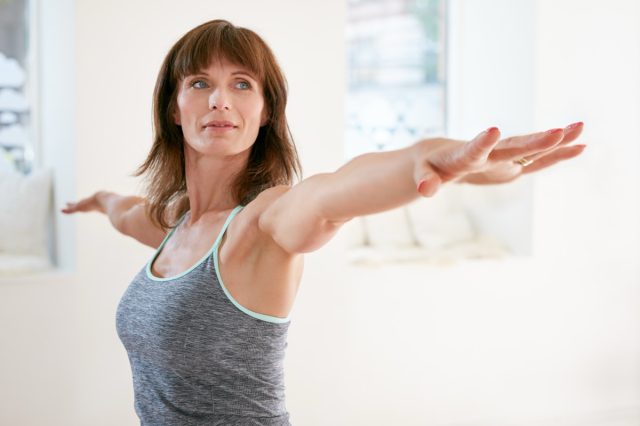
The workout below was designed to improve balance, flexibility, and promote relaxation for those 65+. It emphasizes gentle movements that can be completed while lying in bed.
“By following this routine regularly, you can enhance your balance, flexibility, and overall well-being,” Bertram says.
RELATED: Over 45? If You Can Wall Sit This Long, Your Body Beats Your Age
Windshield Wipers
- Lie flat on your back with your arms stretched out to the sides to form a “T,” palms facing down.
- Lift your knees so your hips and knees are bent to 90 degrees.
- Press your lower back into the mattress and activate the core.
- Slowly lower your knees to your left side, making sure your shoulders stay pressed into the mattress.
- Hold for a moment on the left side before returning to the center.
- Slowly lower your knees to the right.
- Perform the exercise for 1 minute.
Single Knee to Chest
“This helps in stretching the lower back and improving hip flexibility,” Bertram notes.
- Lie flat on your back with legs extended.
- Squeeze one knee in toward your chest with both hands.
- Hold for a moment before releasing.
- Alternate knees, performing the exercise for 1 minute.
RELATED: This 15-Minute Morning Routine Reverses Muscle Loss Faster Than Long Workouts After 45
Knee to Chest Hold
- After alternating the single knee to chest movement, hold each knee to your chest for 30 seconds.
- Keep the position relaxed.
- After holding, complete foot circles for 15 seconds in one direction and then 15 seconds in the other direction for each leg.
Chin Tucks with Arm Position
“[This exercise] lengthens the spine and promotes proper head alignment,” Bertram explains.
- Begin lying flat on the mattress with your arms outstretched to the sides, palms facing up.
- Tuck your chin in toward your chest with each inhale and release on the exhale.
- Perform this exercise for 1 minute.
RELATED: If You Can Master These 3 Bodyweight Movements After 60, You’re Stronger Than Most
Chin Tucks with Clenching Fists
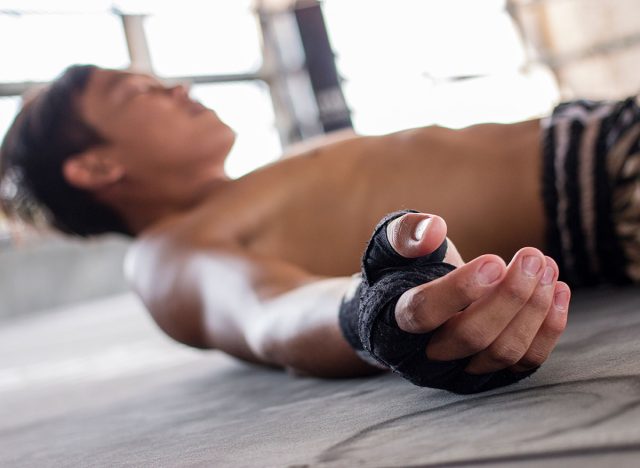
- Continue performing chin tucks, but add clenching your fists with each inhale.
- Release both the chin and fists as you exhale.
- Perform this for 1 minute.
Full-Body Tension Chin Tucks
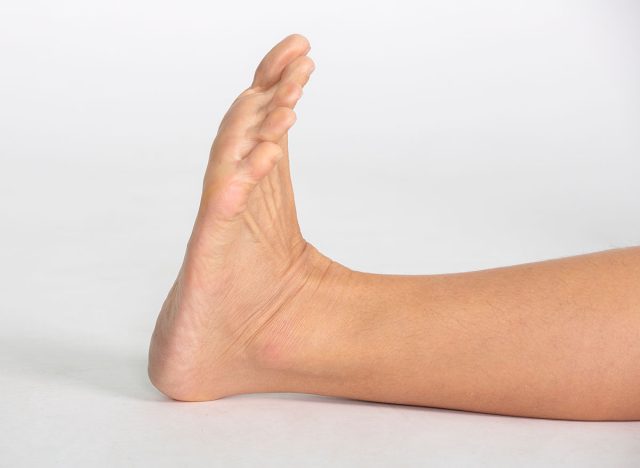
“This combination helps to release tension in the low back, aligns the pelvis, and enhances overall body awareness,” Bertram says.
- Tuck your chin, clench your fists, and flex your feet toward your knees with each inhale.
- Release on the exhale.
- Perform this for 1 minute.
The post The 6-Minute Bed Routine That Restores Full-Body Balance After 65 appeared first on Eat This Not That.
]]>The post The 7-Minute Standing Routine That Restores Full-Body Balance After 65, According to a Coach appeared first on Eat This Not That.
]]>Standing balance work challenges your body in a very functional way by training strength, stability, and body awareness simultaneously. It also builds confidence, which often encourages people to stay more active throughout the day. When I program for clients in this age group, I often prioritize upright movements early because they carry over so well into real-world movement and help reinforce strong, steady mechanics.
The 7-Minute Standing Routine That Restores Full-Body Balance After 65 fits easily into a daily schedule while targeting the muscles that keep you upright and controlled. With just your body weight and a small open space, you can train coordination, stability, and lower-body strength in one efficient session. Here’s exactly how to perform the routine for the best results.
RELATED: 5 Bed Exercises That Firm Inner Thigh Looseness After 55, According to a Coach
The 7-Minute Standing Routine That Restores Full-Body Balance After 65
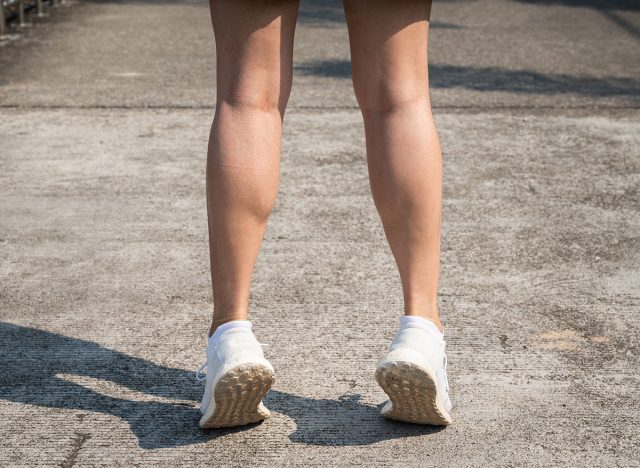
What you need: Open floor space and a sturdy chair or wall nearby for light support if needed. This routine uses controlled standing movements performed in short intervals to challenge balance and full-body stability. Total time is seven minutes.
The Routine: Complete the circuit for 3 rounds. Rest minimally between each exercise.
- Standing March Hold: 30 seconds
- Heel-to-Toe Walk: 30 seconds
- Single-Leg Reach: 30 seconds
- Standing Calf Raises: 30 seconds.
Directions
Set a timer for 30-second intervals. Perform each exercise back-to-back in the order listed. Move with control and focus on staying tall through your posture. Complete the full circuit three times for a total of seven minutes of work. Read on for the detailed instructions.
Standing March Hold
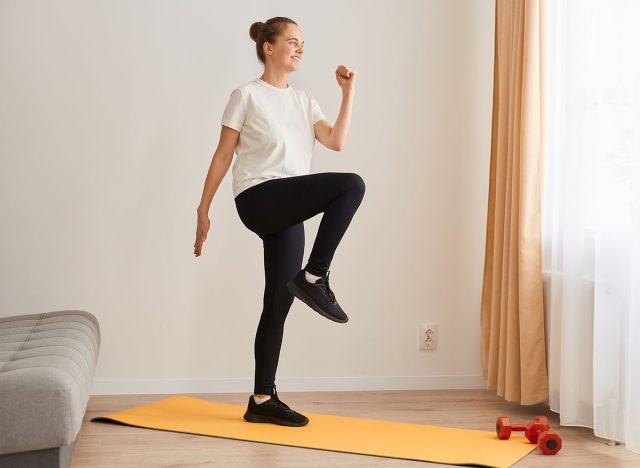
Link:
The standing march hold builds single-leg stability and teaches your body to control weight shifts with precision. This directly supports walking mechanics and helps reinforce hip stability, which plays a major role in maintaining balance as you age. I like this movement because it quickly reveals and improves side-to-side control while staying very joint friendly. Over time, stronger single-leg stability makes everyday movement feel smoother and more confident.
How to do it:
- Stand tall with your feet hip width apart.
- Lightly brace your core and keep your chest lifted.
- Lift one knee to hip height.
- Hold the position while balancing on the standing leg.
- Keep your hips level and posture tall.
- Lower with control and switch sides halfway through the interval.
Best Variations:
- Light fingertip support march hold
- Slower tempo march hold
- Eyes-closed march hold for advanced balance.
RELATED: If You Can Do This Many Squats After 50, Your Lower-Body Power Is Top 10%
Heel-to-Toe Walk
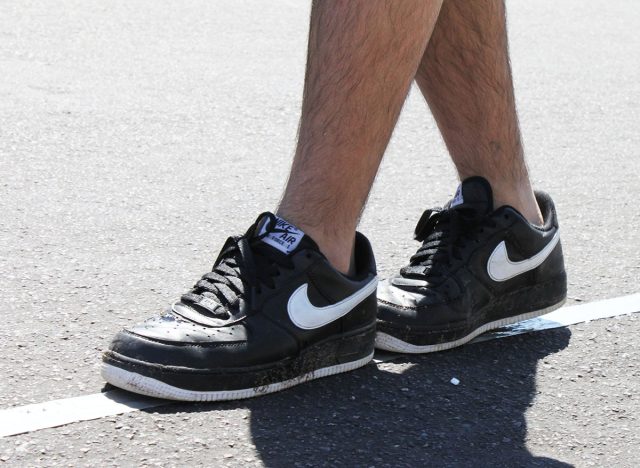
Link:
The heel-to-toe walk strengthens your gait pattern and improves coordination between your lower body and core. This movement challenges your ability to control forward motion while staying aligned, which carries over strongly to everyday walking. Many adults notice quick improvements in body awareness when practicing this drill consistently. I program it often because it builds balance in motion, not just in place.
How to do it:
- Stand tall in an open space.
- Step forward, placing the heel of your front foot directly in front of the toes of your back foot.
- Shift your weight forward slowly.
- Keep your eyes forward and torso upright.
- Continue walking in a straight, controlled line for the full interval.
Best Variations:
- Slower heel-to-toe walk
- Narrow line walk
- Light fingertip wall support.
RELATED: 5 Daily Exercises That Flatten Apron Belly Faster Than Crunches After 50
Single-Leg Reach
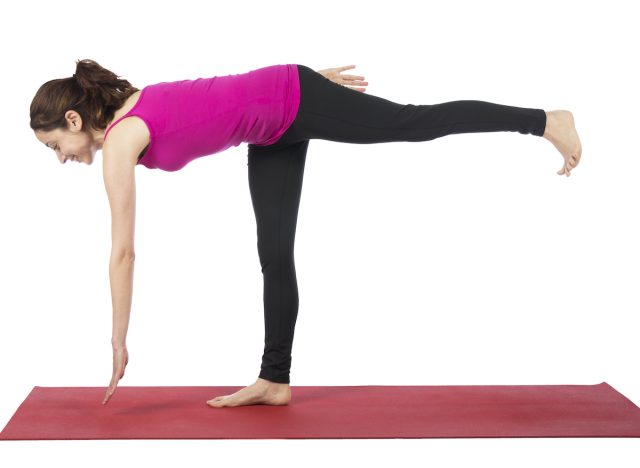
Link:
The single-leg reach challenges your balance while teaching your hips and core to stabilize during movement. It strengthens the muscles around the hips and improves your ability to control your center of mass, which plays a major role in fall prevention. In my experience, this exercise creates a strong carryover into real-world tasks like bending and reaching. It also builds confidence in single-leg control, which many adults find empowering.
How to do it:
- Stand tall with feet hip-width apart.
- Shift your weight onto one leg.
- Reach the opposite leg slightly behind you.
- Hinge forward a few inches while keeping your back flat.
- Return to the starting position with control.
- Switch sides halfway through the interval.
Best Variations:
- Toe-tap reach
- Supported single-leg reach
- Longer reach progression.
RELATED: 5 Dumbbell Exercises Men Over 55 Should Do Each Morning to Build Muscle
Standing Calf Raises
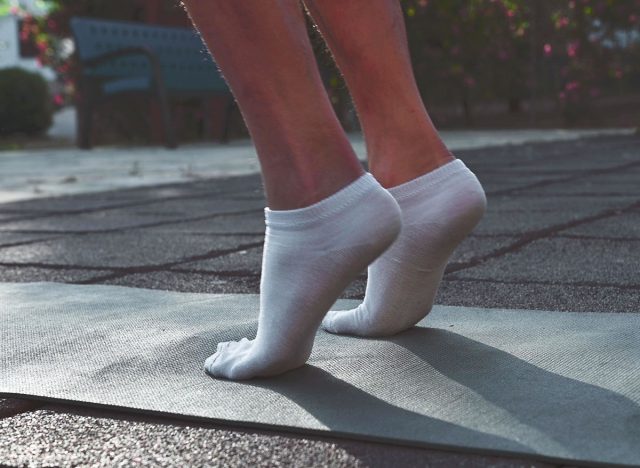
Link:
Strong calves play a key role in ankle stability and overall balance. Calf raises strengthen the muscles that help you control forward movement and react quickly to small shifts in position. Many people overlook this area, yet it contributes significantly to steady walking and a confident push-off with each step. I include calf work in nearly every balance program because it supports the foundation of stable movement.
How to do it:
- Stand tall with feet hip-width apart.
- Lightly brace your core and keep your posture upright.
- Press through the balls of your feet to rise onto your toes.
- Pause briefly at the top.
- Lower slowly back to the floor.
- Repeat for the full interval.
Best Variations:
- Single-leg calf raises
- Slow tempo calf raises
- Supported calf raises.
Best Daily Habits to Improve Balance After 65

Restoring balance works best when short workouts pair with smart daily movement habits. The body responds quickly when you practice stability in small doses throughout the week. In my coaching experience, clients who see the biggest improvements usually focus on consistency and body awareness during everyday movement. Balance training thrives on repetition and quality effort. When you reinforce these patterns daily, your confidence and control tend to rise together. Use the habits below to support your progress.
- Practice balancing work daily. Frequent exposure helps your nervous system adapt faster.
- Stay physically active throughout the day. Regular movement keeps coordination sharp.
- Keep your posture tall during walks. Upright alignment supports better balance mechanics.
- Strengthen your lower body consistently. Strong hips and calves create a stable base.
- Use support when needed and progress gradually. Confidence builds faster with safe, controlled practice.
- Challenge your balance slightly over time. Small progressions keep your body adapting.
Stay consistent with this seven-minute routine and these daily habits, and most adults over 65 begin to notice steadier movement, better control, and greater confidence on their feet.
References
- Wang, Jixian et al. “Age-Related Dysfunction in Balance: A Comprehensive Review of Causes, Consequences, and Interventions.” Aging and disease vol. 16,2 714-737. 24 Jan. 2024, doi:10.14336/AD.2024.0124-1
- de Abreu, Daniela Cristina Carvalho et al. “Standing balance test for fall prediction in older adults: a 6-month longitudinal study.” BMC geriatrics vol. 24,1 947. 15 Nov. 2024, doi:10.1186/s12877-024-05380-9
The post The 7-Minute Standing Routine That Restores Full-Body Balance After 65, According to a Coach appeared first on Eat This Not That.
]]>The post 5 Daily Exercises Women Over 60 Should Do to Maintain Balance and Strength appeared first on Eat This Not That.
]]>RELATED: The 8-Minute Daily Routine That Restores Thigh Strength After 55, According to a Trainer
Why Falls Are the Biggest Risk

The single greatest risk for women over 60, without a doubt, is falls. A fall after the age of 60 is not just a minor mishap; it can be a truly life-altering event, leading to a hip fracture, loss of independence, and a deep-seated fear of falling again, which then causes a person to become even less active, leading to a very vicious cycle.
So what exactly is happening in our bodies that makes this risk so much higher? It’s really a double whammy of losing strength and losing our sense of balance at the same time.
First, there’s a natural process called sarcopenia, which is just a fancy term for age-related muscle loss. After the age of 30, we can lose 3-8% of our muscle mass per decade, and this process really speeds up for women after menopause. The muscles in our legs and our core are our foundation. They’re what hold us up, allow us to get out of a chair, and most importantly, catch ourselves when we trip so that we don’t fall. When that strength declines, our foundation becomes shaky.
Then there’s the balance system itself, which gets less reliable as we age. I like to explain it this way: your balance is like a three-legged stool. One leg is your vision, which helps you stay oriented. The second leg is your inner ear, which works kind of like a built-in gyroscope. And the third leg, which people don’t think about as much, is something called proprioception: basically, the feedback your feet and legs send to your brain about where you are in space. As we get older, all three of these can start to falter. Maybe your vision isn’t quite as sharp, or you’ve got some inner ear changes, or those nerve signals from your feet aren’t firing as quickly. The result? When you trip or lose your footing, your body’s reaction time to catch yourself just isn’t what it used to be.
I actually had a patient, a wonderful woman named Carol, who came to me after she tripped on her own rug. She didn’t break anything, thank goodness, but she was terrified. She told me she used to be so steady on her feet, and now she felt like she couldn’t trust her own body. We worked on some very simple, targeted exercises, and the biggest change wasn’t just her physical stability but the return of her confidence. That’s the real goal here: to feel confident and safe in your own body again.
Why These Exercises Work for Daily Practice
If an exercise isn’t safe, you won’t do it. And if you don’t do it consistently, it won’t be effective. The beauty of these exercises is that they were designed with the 60+ body in mind. They are gentle, low-impact, and can be done every single day.
What makes them safe? A couple of things. First, everything is done slowly and with control. No jumping around, no sudden movements. Your joints, those knees, hips, and ankles that have been working hard for you all these years, will appreciate that. Second, you always start with something to hold onto, whether that’s a chair or a wall. Think of it as your safety net. It lets you work on your balance without that fear of toppling over. And you only let go of that support when you feel ready, not a moment before.
Their effectiveness really lies in their consistency and specificity. Doing these movements daily re-trains the connection between your brain, your muscles, and your nerves. It’s like practicing a musical instrument; the more you do it, the more natural it becomes. You’re waking up those neural pathways that may have become a little sleepy over the years. Daily practice helps make balance an automatic reflex again, not something you have to consciously think about.
These exercises target the exact muscles that matter most for stability: the glutes (your powerhouse hip muscles), the leg muscles (quads, hamstrings, and calves), and the deep core muscles. By strengthening these specific areas in a coordinated way, you’re not just building strength, you’re building functional strength, the kind you need to walk on uneven ground, carry groceries, or get up from the floor.
RELATED: 5 Daily Hip Exercises That Protect Your Back After 50, According to a Trainer
Sit-to-Stand
This is arguably the most important functional exercise for maintaining independence. It strengthens the major muscles in your legs, which you need to get up from a chair, out of a car, and off of the toilet. It’s a direct counterattack against muscle loss.
Muscles Trained: Quads, glutes, hamstrings
How to Do It:
- Sit on the front half of a sturdy chair (one that won’t roll away!) with your feet flat on the floor, about hip-width distance apart.
- Cross your arms over your chest or hold them out in front of you.
- Lean forward slightly, keeping your back straight and chest up.
- Push through your heels and stand up completely. Think about squeezing your glutes at the top.
- Slowly and with control, reverse the motion and sit back down. Try not to just “plop” down.
Easier Modification: If standing up without using your hands is too difficult, that’s perfectly okay. Start by placing your hands on the chair’s armrests or on your thighs and use them to help you push up. Over time, try to use less and less arm assistance.
Avoid These Mistakes:
- Don’t rock back and forth to get yourself up. The work should come from your legs, not momentum.
- Don’t let your knees cave inward. Keep your knees in line with your feet as you stand up and sit down.
- Don’t hold your breath. Exhale as you stand up, and inhale as you sit down.
Form Tip: Think about driving through your heels, not your toes, as you stand. This keeps the effort in your glutes and hamstrings where it belongs.
Tandem Stance
This exercise directly challenges your balance by narrowing your base of support, forcing your body to make small adjustments to stay upright. It is fantastic for retraining the communication between your feet, your brain, and your muscles.
Muscles Trained: Core, ankles, calves, hip stabilizers
How to Do It:
- Stand next to a wall or a sturdy countertop, with your hand lightly touching it for support.
- Place the heel of one foot directly in front of the toes of the other foot, as if you were walking on a tightrope.
- Stand tall, look straight ahead, and try to hold this position for 10-15 seconds.
- Switch feet and repeat.
Easier Modification: If the full tandem stance is too wobbly, start with a “semi-tandem” stance. Instead of placing your feet in a perfect line, offset them slightly so the heel of your front foot is touching the big toe of your back foot. This gives you a slightly wider base of support.
Avoid These Mistakes:
- Don’t look down at your feet. This will throw your balance off. Keep your gaze fixed on a point in front of you.
- Don’t lean heavily on your support. The wall or chair is for safety, not for bearing your weight. Try to just hover your hand over it, or touch it with only one or two fingers.
- Don’t hold your body stiff. Allow for small, natural sways. Your body is supposed to make tiny adjustments.
Form Tip: Think of the wall or countertop as a safety net, not a crutch. The less you rely on it, the harder your balance system has to work.
RELATED: 5 Standing Exercises That Shrink Apron Belly Faster After 55, According to a Coach
Single-Leg Stance
This is a classic balance-builder. It strengthens the muscles in your standing leg, hip, and core, all while improving your stability. This is the skill you need when you have to step up onto a curb or quickly shift your weight from one foot to the other.
Muscles Trained: Glutes, quads, core, hip stabilizers
How to Do It:
- Stand behind a sturdy chair or next to a countertop, holding on with both hands.
- Plant your feet firmly on the ground, hip-width apart.
- Slowly lift one foot off the ground, bending your knee. Don’t worry about how high you lift it.
- Focus on keeping your standing leg strong and your posture tall. Try to hold for 10 seconds.
- Lower your foot back down with control and switch to the other side.
Easier Modification: Don’t lift your foot all the way off the floor. Simply rest the toes of your lifted foot on the ground for a little extra support, like a kickstand on a bicycle. This is called a “staggered stance” and it’s a great starting point.
Avoid These Mistakes:
- Don’t slouch or lean to one side. Try to keep your body as upright as possible. Imagine a string pulling the crown of your head up to the ceiling.
- Don’t lock the knee of your standing leg. Keep a tiny, micro-bend in your standing knee to protect the joint and engage the muscles properly.
- Don’t look around the room. Find a spot on the wall in front of you and fix your gaze there to help you stay steady.
Form Tip: The kickstand modification is a smart way to build up to the full version. There’s no rush.
Heel-to-Toe Walk
This exercise simulates walking on a narrow path and is a fantastic way to improve dynamic balance, which is balance while you are moving. It improves coordination and forces you to slow down and be very deliberate with your foot placement.
Muscles Trained: Calves, ankles, core, hip stabilizers
How to Do It:
- Find a clear path in your home, perhaps alongside a wall or a long countertop that you can lightly touch for support.
- Stand tall and take a step forward, placing the heel of your front foot directly in front of the toes of your back foot. It should feel like you’re on a tightrope.
- Pause for a moment, then take the next step with your other foot in the same heel-to-toe fashion.
- Aim to take 10-15 steps forward.
Easier Modification: Instead of walking heel-to-toe, just try to walk in a straight line, placing one foot directly in front of the other without them touching. You can also take shorter steps.
Avoid These Mistakes:
- Don’t rush. This exercise is all about slow, controlled movement. Speed is your enemy here.
- Don’t stare down at your feet the whole time. Try to look ahead, only glancing down when you need to check your foot placement.
- Do use your arms. Allow your arms to be out to the side to help you balance, just like a tightrope walker would.
Form Tip: Slow is the name of the game here. If you feel like you’re going too fast, you are.
RELATED: The 10-Minute Standing Routine That Rebuilds Lost Arm Muscle After 55, According to a Coach
Side Leg Raise
This move strengthens your hip abductor muscles, which are on the outside of your hips. These muscles are incredibly important for stabilizing your pelvis when you walk and for preventing you from falling over sideways. Many people neglect these muscles, but they are a key to stability.
Muscles Trained: Hip abductors (gluteus medius), core
How to Do It:
- Stand behind a sturdy chair or next to a countertop, holding on for support.
- Stand tall with your feet together.
- Slowly lift one leg straight out to the side, keeping your leg straight and your toes pointing forward. Don’t worry about lifting it high; just a few inches is effective.
- Hold for a second at the top, then slowly lower the leg back down with control.
- Complete 10-12 repetitions on one side before switching to the other.
Recommended Sets and Reps: 10-12 reps per side.
Easier Modification: If lifting your leg is too challenging, you can do a simple side step instead. Just step one foot out to the side, tap your toe, and bring it back to the center. This still engages those important hip muscles.
Avoid These Mistakes:
- Don’t lean your torso to the opposite side. The movement should come from your hip. Keep your torso upright.
- Don’t swing the leg. Use your muscles to lift and lower your leg with control. Avoid using momentum.
- Don’t point your toes up to the ceiling. This turns the exercise into a quad exercise. Keep your foot parallel to the floor to target the hip muscles correctly.
Form Tip: Think “lift from the hip,” not “lean and kick.” If your upper body is swaying, lower the height of your leg lift and focus on control.
Equipment and Time
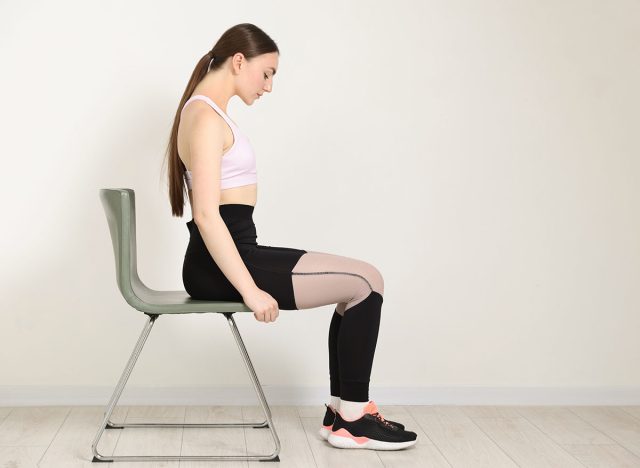
This is the best part, honestly. You need next to nothing! The only piece of equipment I insist on is a sturdy, stable chair that won’t slide or roll. A solid kitchen chair or a heavy dining room chair is perfect. Please don’t use an office chair with wheels! You can also use a kitchen countertop or a wall for support.
That’s it. No expensive gym memberships or fancy gadgets. The most important thing is consistency, and these exercises are designed to be done anywhere, anytime.
As for how long it takes, you can get through this entire routine in 10 to 15 minutes. That’s it! It’s less time than it takes to drink a cup of coffee and read the morning headlines. The goal is to make this a small, manageable part of your daily routine, like brushing your teeth. When a habit is this easy to fit in, you’re so much more likely to stick with it, and that’s where the real magic happens.
RELATED: 5 Daily Exercises That Shrink Belly Overhang Faster Than Weight Training After 55
How to Progress These Exercises
Progression is a sign that you are getting stronger and more stable. The key is to challenge yourself a little bit, but not so much that you feel unsafe. Think of it as turning up the dial on your balance, not flipping a switch.
For the Sit-to-Stand, the first step is to use your hands less and less. Maybe you start by pushing off with both hands, then progress to just one hand, then just your fingertips, and finally to crossing your arms over your chest. Another great way to make it harder is to slow down the “sitting” part of the movement. Try to take a full five seconds to lower yourself back into the chair. This will build tremendous control.
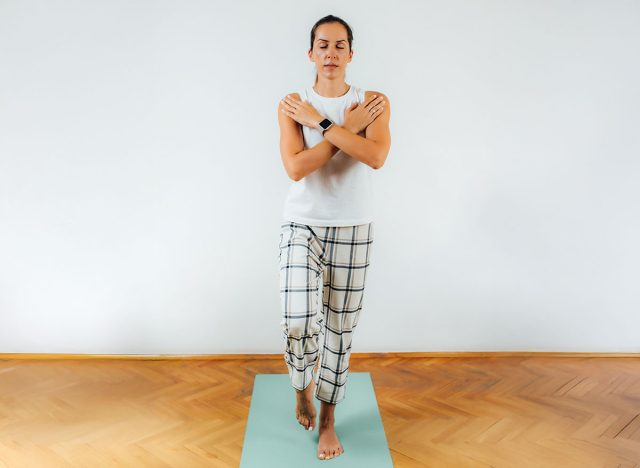
For the Tandem Stance and Single-Leg Stance, the progression is all about reducing your reliance on support. Start by holding on with your whole hand, then just a few fingers, then just one finger. The next step is to just hover your hand over your support without touching it. Once you can hold the stance for 30 seconds without support, you can add a challenge: try turning your head slowly from side to side or closing your eyes for just a second or two. Make sure you are in a safe spot!
For the Heel-to-Toe Walk, the first progression is to let go of the wall or countertop. Once you can do that confidently, try taking a few steps backward in the same heel-to-toe manner. This is much harder than it sounds! You can also try carrying a light object, like a book or a small can of soup, to add a little bit of dynamic challenge.
For the Side Leg Raise, you can add a one or two second pause at the top of the movement. You can also add a light ankle weight (just 1-2 lbs is plenty) or a small resistance band loop around your ankles to increase the resistance and build more strength in those hip muscles.
The most important rule of progression is to listen to your body. If you feel wobbly or unsafe, take a step back to the previous level. The goal is to build confidence, not to create fear.
RELATED: 4 Standing Exercises That Flatten Side Belly After 45, According to a Trainer
What to Expect in 30 Days
You can absolutely feel a difference in 30 days if you are consistent. The key is to know what to look for.
The first thing you’ll likely notice, probably within the first week or two, isn’t a dramatic physical change, but a change in your confidence. You’ll feel more “connected” to the ground. When you stand up from a chair, it will feel more solid. When you walk, you’ll feel a little less tentative or hesitant. These are the first, wonderful signs that your brain and muscles are starting to work better together.
By the end of 30 days, you should notice more tangible results. You might be able to stand on one leg for a few seconds longer than you could at the start. You might be able to do the sit-to-stand exercise without using your hands at all. Maybe you can walk heel-to-toe without holding onto the wall. These are huge victories!
I had a client who, at the start, couldn’t let go of her kitchen counter while trying to stand on one leg. After a month of doing these exercises almost every morning, she called me, excited, to say that she had stood on one leg long enough to put her sock on without holding onto anything. For her, that was more meaningful than any number on a chart. It was a piece of her independence back.
So, in 30 days, expect to feel more stable, more confident, and more in control of your body. The visible strength gains take a bit longer, but the foundation for them, and for a safer, more active life, will be firmly in place.
The post 5 Daily Exercises Women Over 60 Should Do to Maintain Balance and Strength appeared first on Eat This Not That.
]]>The post 4 Seated Exercises That Improve Balance Faster Than Yoga After 55 appeared first on Eat This Not That.
]]>“The more muscle you have, and the more of that muscle is made up of type 2 ‘fast twitch’ motor units, the more likely you are to have better general ‘balance’ as you age,” explains Herlihy. “This will make you less susceptible to losing your balance in the real world, and is one of the most important things that will turn a simple ‘slip’ into a devastating and debilitating fall.”
For those who want to boost balance—even those new to strength training—here are five seated exercises that will improve the size, strength, muscle quality, and balance in your legs.
Seated Leg Press
“If you had to pick one exercise for overall leg development, this would be it. A properly performed leg press will target everything from your hips down to your ankles,” Herlihy explains.
Choose a weight that feels challenging but allows you to perform the prescribed reps with solid form.
- Sit at the leg press machine, pressing your back flat into the pad and feet hip-width apart on the platform.
- Your knees should be just below a 90-degree bend.
- Hold the handles or sidebars for support.
- Press through both heels to extend your legs.
- Use control to return to the start position.
- Your last rep should feel as though it would be challenging to do 2 more reps.
- Complete 3 sets of 15 to 20 reps with roughly 2 minutes of rest in between each set.
RELATED: The 16 Best Exercises To Regain Your Balance After 60
Seated Leg Extension
“This exercise will grow your quadriceps (the front of your thighs) directly. In [longevity studies,] leg extensions are the primary exercise used to increase quadriceps strength and thickness,” Herlihy says. “Avoid ‘bouncing’ in the contracted position. Instead try to squeeze your quadriceps for a full second when extended. This will target the rectus femoris muscle directly (the little muscle that bulges out just above your knee joint in well developed quads).”
Choose a weight that allows you to complete the prescribed reps with solid form.
- Set the seat so that your knee lines up with the pivot point on the leg extension machine.
- Line up the leg pad just over your ankle, around the bottom third of the shin.
- Hold onto the handles.
- Extend your legs as you gradually lift the weight until your legs are almost straight.
- Hold at the top before using control to lower.
- Your last rep should feel as though it would be challenging to do 2 more reps.
- Complete 3 sets of 15 to 20 reps with roughly 2 minutes of rest in between each set.
RELATED: 4 Balance Exercises That Build Strength & Stability Over 40
Seated Leg Curl
“This exercise specifically targets the hamstring musculature. The muscles in the backs of your thighs which help with posture, balance, and grow exceedingly tight as we age from extended periods of sitting,” Herlihy tells us.
- Sit at the leg curl machine, placing the back of your lower legs against the padded lever.
- The thigh pad should be properly fitted across your upper thighs.
- Gradually pull your heels down and back, bending your knees to curl the weight.
- Hold at the bottom for a moment before returning to the start position.
- Your last rep should feel as though it would be challenging to do 2 more reps.
- Complete 3 sets of 15 to 20 reps with roughly 2 minutes of rest in between each set.
RELATED: Over 45? If You Can Stand on One Leg This Long, Your Balance Is Stronger Than Most
Seated Adduction
“The adductors are one of the most overlooked areas of leg training. Men typically avoid this machine like the plague. However, these inner thigh muscles are extremely important for horizontal movement, which makes them extremely important for balance,” Herlihy explains.
- Adjust the seat height so your hips are back and your lower back is pressed into the pad.
- Position your inner thighs against the padded levers, and take hold of the handles.
- Press the pads inward as you squeeze your inner thigh muscles.
- Use control to release.
- Your last rep should feel as though it would be challenging to do 2 more reps.
- Complete 3 sets of 15 to 20 reps with roughly 2 minutes of rest in between each set.
The post 4 Seated Exercises That Improve Balance Faster Than Yoga After 55 appeared first on Eat This Not That.
]]>The post If You Can Hold These 3 Standing Exercises After 50, Your Balance Is Exceptional appeared first on Eat This Not That.
]]>How Balance Changes After 50
As you age, your body naturally changes. For instance, balance becomes more complex.
“After you hit 50, it’s not just about muscles; it’s a total body conversation between your brain, nervous system, sensory feedback, joints, and muscular control,” explains Felicia Hernandez, NASM-certified personal trainer and community engagement lead at Eden Health Club.
Major culprits behind a decline in balance include stiff joints, changes in vision, the loss of lower-body muscle mass (particularly in the hips, glutes, and ankles), weakened proprioception, and slower nerve conduction, which leads to slower reaction time.
“All of this adds up to one thing: Your body stops trusting itself in space,” Hernandez tells us. “The good news is that this is completely trainable. I have seen balance work help. With focused balance work, you’re not just preventing falls; you’re retraining the brain and your body to function sharply together.”
RELATED: If You Can Pass These 3 Drills, You’re Moving Better Than Most People at Any Age
These 3 Standing Exercises Signal Strong Balance
According to Hernandez, these standing holds support real-world balance demands while firing up the stabilizing muscles from the ground up.
Single-Leg Stand, Barefoot (Eyes Open or Closed)
“This reveals your true balance baseline. Eye closure forces your proprioceptive system to activate fully. If you can hold this for 20+ seconds without wobbling, your stabilizers are on point,” Fernandez points out.
- Stand tall on a flat surface with your feet hip-width apart and arms at your sides.
- Shift your body weight onto your left foot.
- Lift your right foot off the floor.
- Activate your core while keeping your shoulders stacked over your ribs and your hips level.
- The time begins once your leg comes off the floor and stops when your foot touches the ground.
- Progress the exercise by closing your eyes.
- Perform 3 sets of 20 to 30 seconds on each leg.
RELATED: If You Can Hold These 4 Standing Positions After 55, Your Core Strength Is Elite
Staggered Stance Overhead Reach Hold (Unilateral Load)
“Holding a load overhead pulls on your entire midline, lighting up your core, glutes, and foot stabilizers. The split stance challenges gait and dynamic balance—key components of fall prevention,” Fernandez tells us.
- Assume a split stance with one foot forward.
- Hold a small dumbbell in one hand, extending that arm overhead.
- Keep your ribs and hips stacked.
- Perform 3 rounds, holding the position for 20 seconds on each side.
RELATED: The 6-Minute Daily Routine That Restores Upper-Body Strength Better Than Weight Training After 55
Heel-to-Toe Line Hold (Tandem Stance)
“This narrow base of support challenges lateral stability and ankle strength—two of the first things to go with age,” Fernandez points out.
- Position one foot directly in front of the other with your front heel against your back toes, like you’re about to walk on a tightrope.
- Pull the crown of your head upward, and activate your glutes to stand tall.
- Perform 3 rounds of 30 seconds on each side.
RELATED: 6 Morning Exercises That Restore Hip Strength Faster Than Floor Stretches After 55
Why These Exercises Matter
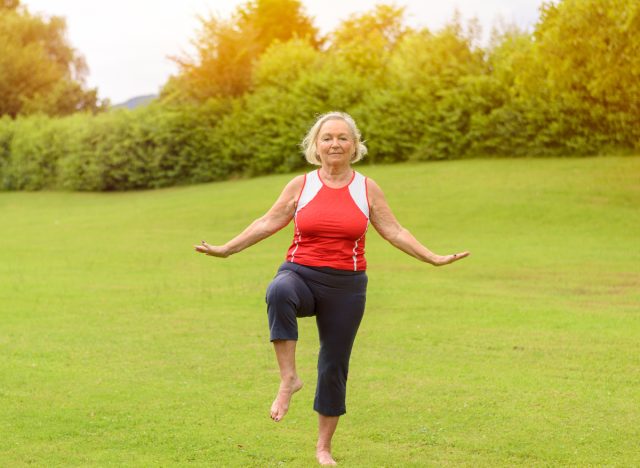
“Because you are dealing with the shifts, inside your body, the muscles, the joints, the eyes, and the inner ear have to synchronize. Think about this: most adults over 50 struggle with flat-ground balance. If you can maintain stillness and integrity during advanced standing holds, that tells us you’ve maintained (and trained) multi-system coordination,” Fernandez points out.
Even a brief standing test can tell a lot about proprioceptive gaps, muscular imbalances, or reduced sensory feedback. Holding these positions with solid form shows that your body is resilient and sharp.
“The important thing is that the signal shows independence. And independence is what we’re really aiming for,” Fernandez adds.
The post If You Can Hold These 3 Standing Exercises After 50, Your Balance Is Exceptional appeared first on Eat This Not That.
]]>The post 4 Daily Balance Drills That Improve Stability Better Than Single-Leg Exercises After 55 appeared first on Eat This Not That.
]]>Balance and stability is everything when it comes to your overall well-being as you age, which is why we spoke to the experts. We learned everything you need to know from Davon Murray, Kinesiotherapist, Personal Trainer, and Director of Fitness Operations at Love. Life, including four daily balance drills that will boost your stability much better than single-leg exercises after 55.
Why This Matters After 55
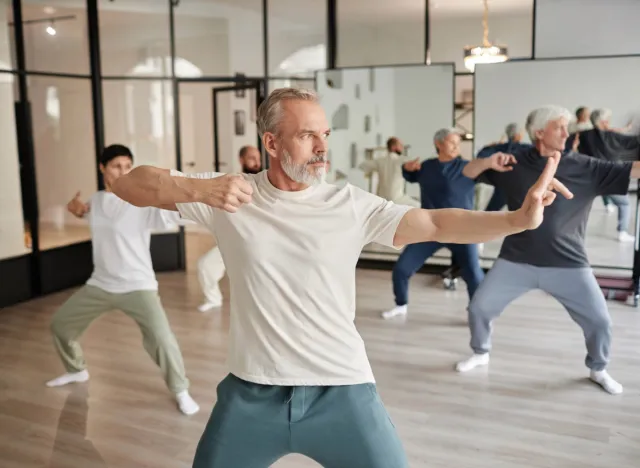
“Balance drills are especially important after age 55, as natural declines in muscle strength, joint mobility, and nervous system function increase the risk of falls,” Murray tells us. “These exercises improve communication between the brain, inner ear, and muscles, allowing the body to respond more quickly to balance challenges. Balance training enhances proprioception, the body’s awareness of position and movement in space. It also strengthens key stabilizing muscles in the hips, ankles, and core that supports posture and walking. Practiced consistently, balance drills help older adults move with greater confidence, stability, and independence in everyday life.”
Balance drills are more effective than simple single-leg exercises because they train balance in multiple directions and mimic how people move in daily life.
Here are four to include in your workout routine that will dramatically improve stability.
RELATED: If You Can Master These 4 Moves After 50, You’re Stronger Than Most
Slow Side-To-Side and Forward-Back Weight Shifts
- Stand tall with your feet hip-distance apart.
- Shift your body weight onto your right foot as you lift your left foot slightly off the ground.
- Hold this pose for a moment.
- Then, move your body weight to your left foot as you lift the right foot slightly off the floor.
- Hold for a few seconds before lowering.
RELATED: This Quick Stability Test Reveals How Balanced You Really Are
Standing While Lightly Tapping
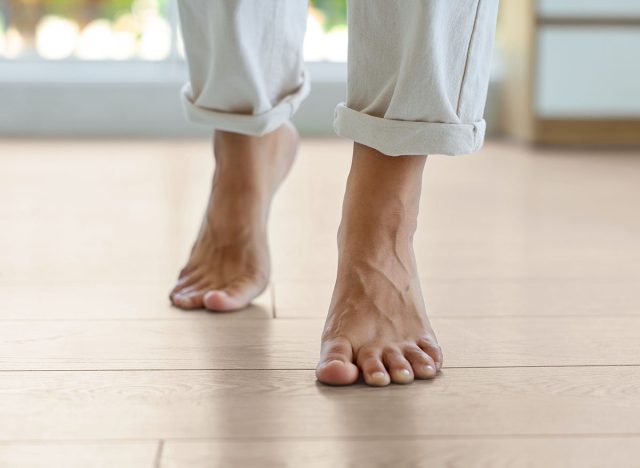
Next up, Murray recommends either standing while performing light taps, or being nudged to practice quick balance corrections.
- From a standing position, lift one leg up and bring that foot forward without holding onto anything for support.
- Tap your foot on the object in front of you.
- Return that foot to the standing position.
- Switch to the opposite leg and complete the same steps.
- Alternate legs, performing 10 reps on each side.
RELATED: The 16 Best Exercises To Regain Your Balance After 60
Controlled Torso Rotations
- Begin standing tall with your feet shoulder-distance apart and arms crossed in front of your chest or reaching out ahead of you.
- Slowly rotate your torso to the left, keeping your hips facing forward.
- Pause for a moment before returning to the center.
- Then, rotate your torso to the right.
- Continue to alternate in a smooth motion.
Stepping on and off a Moving or Vibrating Platform
- Begin standing tall, facing a vibrating platform with your feet hip-distance apart.
- Once the platform is stable or at a low intensity, step onto the center of the surface with one foot, followed by the other.
- Keep your balance for a moment.
- Step one foot down to the floor, followed by the other.
The post 4 Daily Balance Drills That Improve Stability Better Than Single-Leg Exercises After 55 appeared first on Eat This Not That.
]]>The post 4 Balance Tests That Reveal If Your Body Is Aging in Fast-Forward After 50 appeared first on Eat This Not That.
]]>Balance is about more than avoiding falls. It’s about whether your body can react quickly, stabilize under pressure, and move with confidence in everyday life. Whether you’re stepping off a curb, carrying groceries up the stairs, or chasing after a grandkid, strong balance is what keeps you upright and injury-free.
Researchers have even linked poor balance scores to accelerated biological aging, an increased risk of falls, and a decline in independence as we age. Luckily, balance is trainable. Just like lifting weights can strengthen your muscles, practicing balance drills can sharpen your nervous system and keep you moving like someone years younger.
Below are four simple balance tests you can try right at home. If you breeze through them, your body’s aging on schedule, or even in reverse. Struggle with them, and it’s a wake-up call to start sharpening your stability today.
4 Balance Tests to See If Your Body’s Aging Too Fast
Balance Test #1: Single-Leg Stand
Standing on one leg may sound basic, but it’s a gold-standard test for balance and neuromuscular health. If you can’t hold it for at least 10 to 15 seconds, it may signal reduced proprioception (your body’s sense of where it is in space) and declining lower-body strength.
Muscles Trained: Ankles, calves, quadriceps, glutes, core stabilizers.
How to Do It:
- Stand tall with feet hip-width apart.
- Shift your weight onto your right foot.
- Lift your left foot off the floor, bending your knee to 90 degrees.
- Keep your arms relaxed at your sides.
- Hold as long as possible without touching your lifted foot down.
- Switch legs.
Where You Stand:
- Excellent: Hold 20+ seconds per leg
- Average: Hold 10–19 seconds per leg
- Needs Work: Less than 10 seconds per leg
Best Variations: Eyes closed, stand on a pillow, or hold light weights overhead.
Form Tip: Keep your gaze fixed on an object in front of you to steady your posture.
RELATED: 7 At-Home Arm Exercises That Smooth Jiggle
Balance Test #2: Tandem Walk
Walking heel-to-toe in a straight line challenges dynamic balance. This test reveals coordination, ankle stability, and hip strength. Difficulty here often correlates with reduced walking speed and an increased fall risk in older adults.
Muscles Trained: Ankles, calves, hip stabilizers, obliques.
How to Do It:
- Find a flat, clear space about 10 feet long.
- Place your right heel directly in front of your left toes.
- Step forward, placing your left heel directly in front of your right toes.
- Continue heel-to-toe, one foot in front of the other.
- Count how many steps you can take without stepping off line.
Where You Stand:
- Excellent: 8 to 10 steps heel-to-toe without wobbling or stepping off line
- Average: 5 to 7 steps with minor balance checks
- Needs Work: Fewer than 5 steps or frequent stumbles
Best Variations: Walk backward, walk with eyes closed, or carry light weights.
Form Tip: Squeeze your core lightly and keep your arms out to your sides for balance.
RELATED: 5 Belly Fat Mistakes Everyone Makes According to This Doctor
Balance Test #3: Sit-to-Stand Without Hands
Getting up from a chair without using your hands is one of the clearest indicators of lower-body strength and functional independence. If you struggle, it signals weakened quads, glutes, and core, which are all key players for mobility and fall prevention.
Muscles Trained: Quads, hamstrings, glutes, calves, core.
How to Do It:
- Sit on a chair with your feet flat and arms crossed over your chest.
- Engage your core and lean forward slightly.
- Press through your heels and rise to a complete stand without using your hands.
- Slowly lower back down with control.
Where You Stand:
- Excellent: 12+ reps in 30 seconds
- Average: 8 to 11 reps in 30 seconds
- Needs Work: 7 or fewer reps in 30 seconds, or needing hands to stand
Best Variations: Add weight with a dumbbell or backpack, or use a lower chair for difficulty.
Form Tip: Drive through your heels and avoid letting your knees cave inward.
RELATED: 5 Micro-Workout Moves That Shrink Your Stomach Pooch in 30 Days After 45
Balance Test #4: Y-Balance Reach
This test combines single-leg stability with multi-directional reach, showing how well your body can handle challenges outside of the midline. It highlights hip mobility, ankle strength, and coordination; the essentials for reacting to life’s unpredictable movements.
Muscles Trained: Glutes, hip stabilizers, hamstrings, calves, core.
How to Do It:
- Stand on your right leg with your knee slightly bent.
- Reach your left foot forward as far as you can, lightly tapping the ground.
- Return to the start, then reach your left foot out to the side.
- Return, then reach backward.
- Complete all three directions before switching legs.
Where You Stand:
- Excellent: Reach far in all three directions with control and minimal wobble
- Average: Moderate reach with 1 to 2 balance checks
- Needs Work: Unable to maintain stability or losing your balance frequently
Best Variations: Perform barefoot, add a mini-band around your thighs, or extend your arms overhead.
Form Tip: Keep your standing knee soft, not locked, and control each reach without rushing.
RELATED: 5 Daily Standing Moves That Rebuild Lost Muscle After 50
The Final Word: Training Your Balance After 50
If you struggled with any of these tests, don’t treat it as a failure and instead understand it’s feedback. Balance declines naturally with age, but consistent training can slow or even reverse the process.
- Practice one or two balance drills daily.
- Strength train your legs and core 2–3 times per week.
- Add mobility work for your hips and ankles.
- Challenge yourself safely: change surfaces, add resistance, or close your eyes.
Balance is a skill, just like strength or endurance. Train it consistently, and you’ll keep moving with confidence, stability, and youthfulness well past 50.
References
Xie, Kaihong et al. “Balance ability and all-cause death in middle-aged and older adults: A prospective cohort study.” Frontiers in public health vol. 10 1039522. 9 Jan. 2023, doi:10.3389/fpubh.2022.1039522
The post 4 Balance Tests That Reveal If Your Body Is Aging in Fast-Forward After 50 appeared first on Eat This Not That.
]]>